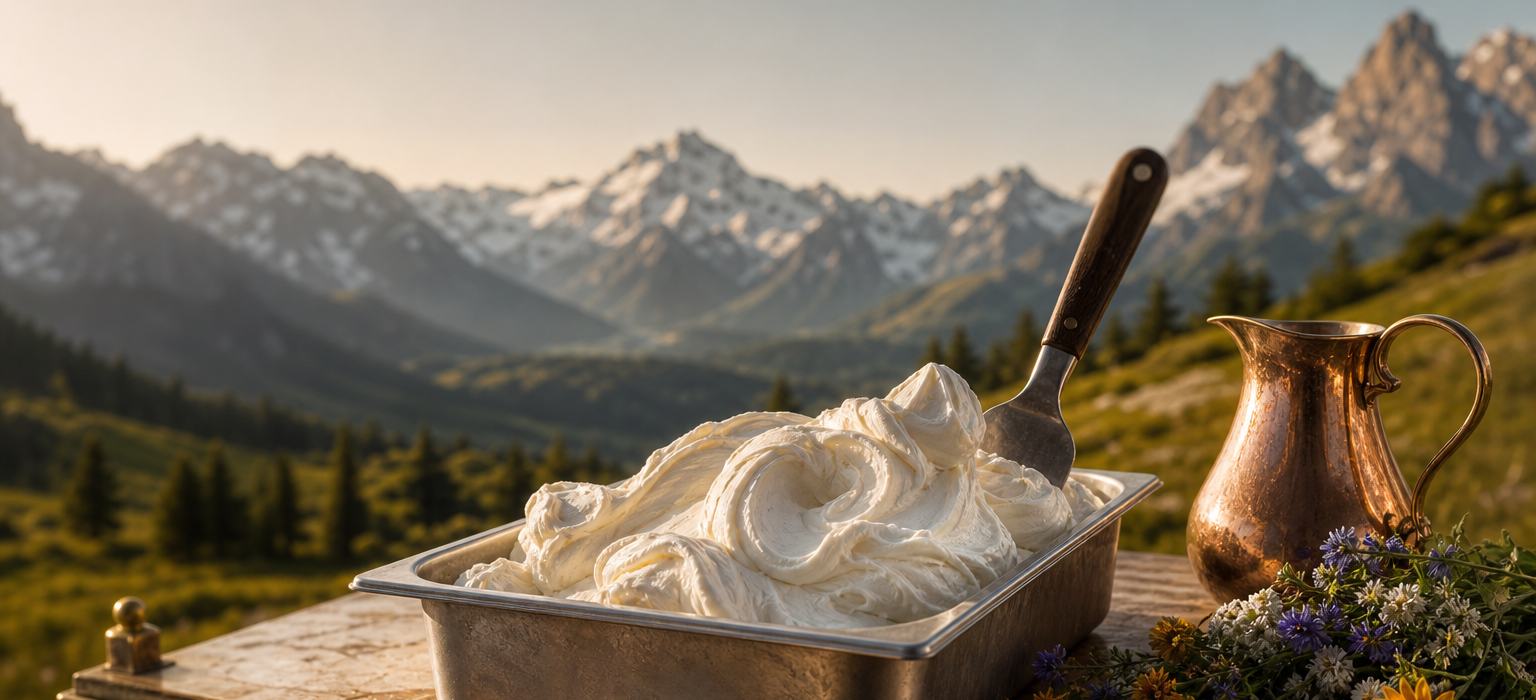
Artisanal gelaterie
Artisanal Gelaterie in the Aosta Valley: The Complete Guide to Aosta, Courmayeur and Cervinia
Symbol flavor: fresh cream — 12 gelaterie, town by town, with maps and verified listings.
The guide
Twelve artisanal gelaterie catalogued across the whole region: no other Italian region counts so few, and for that very reason the Aosta Valley is best read starting from the raw ingredient rather than the addresses. Here gelato is born from mountain milk, in a land where the cheese-making culture of fontina has taught generations of herders to look after the pasture before the finished product. Panna — sweet cream, the emblem flavor this guide has chosen for the region — is no lazy choice: it is the most direct way to taste what working high-altitude milk and cream really means. From Aosta to Courmayeur and on to Cervinia, the map that follows is short but dense.
Aosta Valley herds spend the summer above 1,500 metres: the alpine-pasture milk they send down is the natural base of the mountain cream flavours, dense and clean as the air that produces them.
In Courmayeur and Cervinia, gelato gets two summers: the real one and the white one, when the counters stay open for skiers. Few regions serve cones with snow outside the shop window.
The Renetta apple of the Aosta Valley, grown in mid-altitude orchards, makes honest, lightly sweetened sorbets: exactly the right flavour after a day on the slopes.
Milk First: The Raw Ingredient That Defines the Valley's Gelaterie
In the Aosta Valley the conversation about gelato starts in the cowshed, not the workshop. The region lives on an ancient cheese-making culture built around fontina and its alpine pastures: Valdostana-breed cows, summer grazing above two thousand meters, milk drawn and processed a short distance from where it is produced. For an artisanal gelateria this context is a concrete advantage. Mountain milk, proportionally richer in fat and protein when the animals graze fresh grass, gives a creamy base that needs less intervention: fewer stabilizers, fewer flavorings, fewer corrections in the recipe.
The artisanal gelaterie in the Aosta Valley that do things well say so openly, stating the provenance of the milk and cream at the counter or on the menu. It is a detail the editorial team considers a reliable signal: those who name their supply chain usually honor it. There is no need to hunt for spectacular flavors to gauge the level of a Valdostan workshop; a fior di latte and a crema are enough. If the base is made with true alpine-pasture milk, the difference is there at the first taste, as sharp as the air above fifteen hundred meters.
For an artisanal gelateria this context is a concrete advantage
Panna, the Emblem Flavor of a Land of Alpine Pastures
Every region in this guide has a flavor that represents it, and for the Aosta Valley the choice fell on panna. It may seem the simplest flavor on the counter, and that is exactly the point: panna offers no hiding places. No cocoa to cover, no fruit to distract, just cream, sugar and the gelato maker's hand. In a region where fresh cream comes from valley dairies, this flavor becomes a test of transparency.
It is worth tasting on its own, but also in the role Alpine tradition has always assigned it: next to a slice of apple cake, over a bowl of wild berries, as a counterpoint to a coffee after a day on the slopes. The gelaterie of the Aosta Valley often offer it whipped to order or churned as a flavor in its own right, two different interpretations of the same ingredient. Anyone who wants a benchmark can order it first, before the creative flavors: if the panna convinces, the rest of the display case is unlikely to disappoint.
It may seem the simplest flavor on the counter, and that is exactly the point: panna offers no hiding places
Artisanal Gelaterie in the Aosta Valley: The Addresses in Aosta, Courmayeur and Cervinia
The distribution of the twelve addresses follows the region's geography. Aosta, the capital and only true urban center, holds the largest share of the workshops: here gelato is eaten all year round, among the squares and streets of Roman origin, with a resident public that keeps the bar high even out of season. Courmayeur and Cervinia tell the other side of the valley's gelaterie, that of the ski resorts. The cone after the last run, gloves perhaps still stuffed in a jacket pocket, is a ritual that surprises those who associate gelato only with summer; in the villages at the foot of Mont Blanc and the Matterhorn it works from December to April.
It is precisely this double tourist calendar, winter and summer, that explains why artisanal gelato holds up so well in a region of just over one hundred and twenty thousand inhabitants: there are two peak seasons, not one. Anyone visiting the artisanal gelaterie of the Aosta Valley at the height of summer finds the mountain-fruit flavors; anyone arriving in winter finds shorter displays but richer bases, made for the cold.
Courmayeur and Cervinia tell the other side of the valley's gelaterie, that of the ski resorts
How the Guide to the Aosta Valley's Gelaterie Is Made
The twelve Valdostan addresses on appgelato.it come from public sources: chamber of commerce registers, the businesses' official websites and channels, documented tips. The editorial team verifies that each gelateria is genuinely artisanal, meaning that it produces in a workshop of its own, and updates the entries when a business closes, changes hands or moves premises. No position in the list is paid for and no shop can buy visibility: the order in which the addresses appear reflects no commercial ranking of any kind.
In a small region, mistakes get noticed quickly, and that is a good thing: a wrong entry in Courmayeur gets reported faster than it would in a metropolis. Anyone who finds outdated information can write to the editorial team, which checks and corrects. The small size of the Valdostan sample also has a practical advantage for readers: twelve addresses really can all be tried, valley by valley, within a single season. That is a goal no other regional page in this guide can promise with the same confidence.
Anyone who finds outdated information can write to the editorial team, which checks and corrects
From Mont Blanc Heading South: Where to Continue the Journey
The Aosta Valley borders only one Italian territory, and the natural way down leads to the gelaterie of Piedmont, where the Langhe hazelnut and gianduia open a chapter entirely different from that of alpine panna. Continuing east, you meet the plain and the great urban centers of Lombardy, with a density of workshops at the opposite extreme from the valley's twelve addresses. Heading down toward the sea instead, Liguria puts basil, lemon and riviera fruit on the counter, in a climate that could not be further from that of the Matterhorn.
Comparing territories is one of the most rewarding ways to use this guide: tasting a panna in Aosta and a hazelnut in Turin in the same week says more than many descriptions, because it lays bare the difference between two supply chains and two climates. The starting point, in every region, remains the emblem flavor listed at the top of the page.
The starting point, in every region, remains the emblem flavor listed at the top of the page
The listings
The gelaterie of the Aosta Valley, town by town
FAQ
Gelato in the Aosta Valley: quick answers
How many artisanal gelaterie are there in the Aosta Valley?
The appgelato.it guide catalogues 12 artisanal gelaterie in the Aosta Valley, the smallest number in Italy. Most are concentrated in Aosta, while the others are spread across the tourist resorts, notably Courmayeur and Cervinia. The list is updated by the editorial team as new workshops open or existing businesses close.
Why is panna the emblem flavor of the Aosta Valley?
Because it is the flavor that best tells the story of the local raw ingredient: mountain milk and cream, produced in a region with a powerful cheese-making culture built around fontina and the alpine pastures. Panna contains no ingredients that could mask defects, so it puts the quality of the milk it is made with on full display.
Do people eat gelato in winter in Courmayeur and Cervinia?
Yes. In the valley's ski resorts gelato follows the tourist calendar, which has one of its peaks precisely between December and April. Several workshops stay open through the winter season, with shorter displays and cream-based flavors made to be enjoyed even in sub-zero temperatures.
What is the difference between panna and fior di latte in gelato?
Fior di latte is made primarily from milk, while the panna flavor uses a much higher share of cream, giving a richer, fattier, more enveloping result. In the Aosta Valley both work as a proving ground: if the milk and cream are of alpine quality, the difference between the two flavors comes through clearly.
How are the guide's Valdostan addresses chosen?
The editorial team starts from public, verifiable sources, checks that each business makes its gelato in a workshop of its own and updates the entries over time. No gelateria can pay to appear or to improve its position. Readers' tips are checked one by one before being folded into the regional entries.