Practical guide
Artisanal Gelato Calories: How Many a Scoop Really Contains, with a Flavor-by-Flavor Chart
Gelato calories are the topic that ruins more cones than the August sun melts. The good news is that the real numbers are less dramatic than people assume: a scoop of artisanal gelato remains one of the "lightest" desserts in the Italian pastry tradition, provided you know what you're ordering. Below are the typical weight of a scoop, the calories in artisanal gelato flavor by flavor, and the comparisons that help with choosing: cream or fruit, cone or cup.
One honest caveat before the numbers: every workshop has its own recipes, and artisanal gelato is by nature not standardized. The figures that follow are typical ranges, useful for orientation, not the nutrition label of the counter around the corner.
How much a scoop of gelato weighs
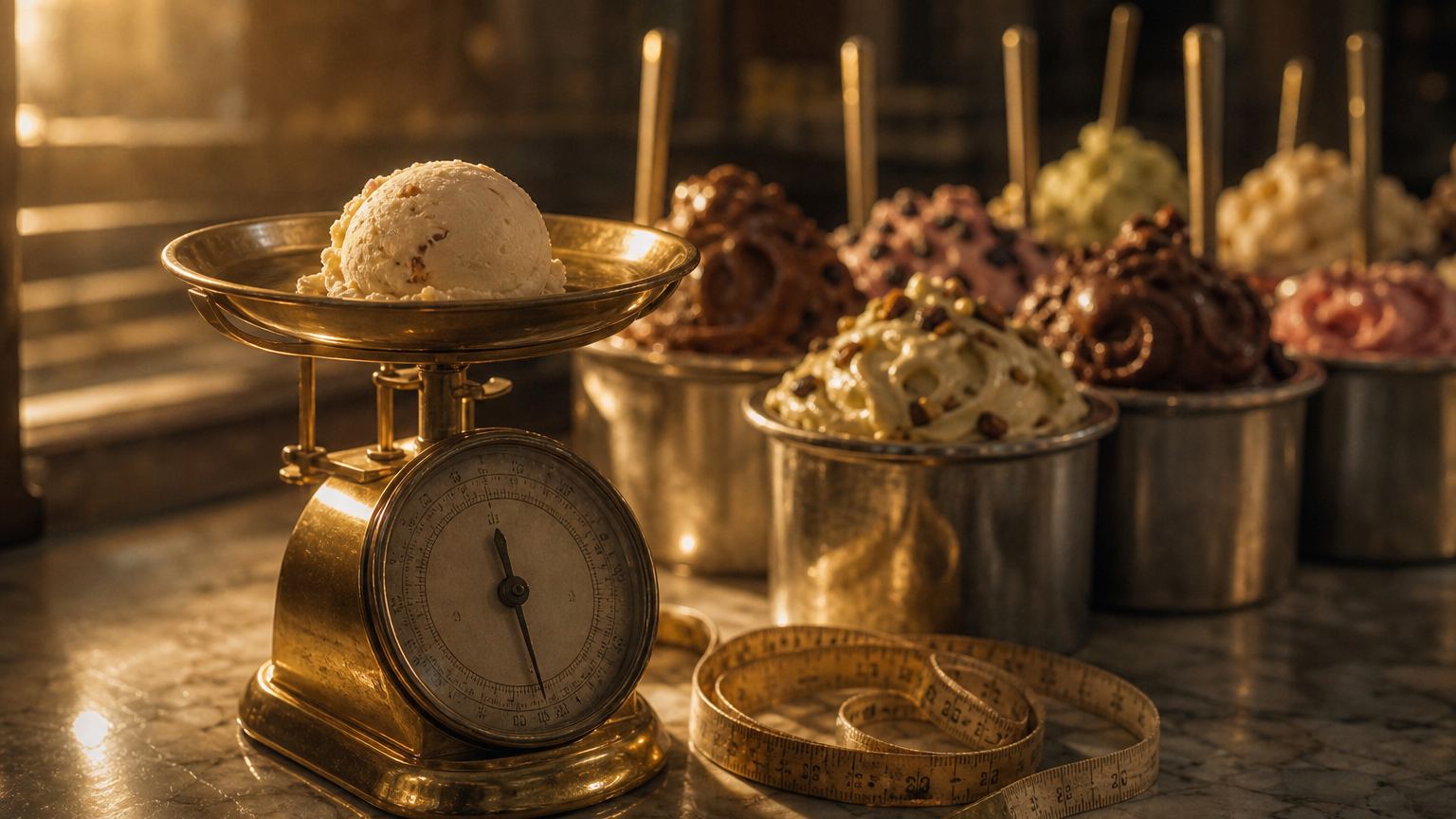
Every calculation starts with weight: anyone wondering how much a scoop of gelato weighs will get different answers from counter to counter. A scoop of artisanal gelato served over the counter generally weighs between 50 and 80 grams: it depends on the portioning scoop used, the gelato maker's hand and how much air the gelato has taken in. Home calculations usually work with an average value of 60-70 grams.
This means the "per 100 grams" figures found in nutrition tables need scaling down: an average scoop contains roughly two thirds of the calories listed for 100 grams. A cream flavor at 200 kcal per 100 grams, for example, translates into a 120-140 kcal scoop: the same order of magnitude as a whole-milk fruit yogurt, not a slice of cake.
A wafer cone adds 40-60 kcal on average, a large or chocolate-coated one even more; a cup, of course, adds zero.
The chart: artisanal gelato calories flavor by flavor
Typical ranges per 100 grams of artisanal gelato, keeping in mind that a scoop weighs about 60-70 grams:
| Flavor | kcal / 100 g (typical) | kcal / scoop (~65 g) |
|---|---|---|
| Lemon sorbet | 110–130 | 70–85 |
| Fruit sorbets (strawberry, peach) | 110–140 | 70–90 |
| Fior di latte | 160–200 | 105–130 |
| Yogurt | 150–190 | 100–125 |
| Crema (egg custard) | 180–220 | 115–145 |
| Stracciatella | 190–230 | 125–150 |
| Chocolate | 200–240 | 130–155 |
| Hazelnut | 210–260 | 135–170 |
| Pistachio | 220–270 | 145–175 |
| Gianduia / cremini | 230–280 | 150–180 |
The logic is easy to read at a glance: more water and fruit, fewer calories; more noble fats — milk, cream, nuts — and the count climbs. Pistachio, hazelnut and gianduia flavors are the most calorific precisely because nut paste is rich in fats, the same fats that make them the best-loved flavors on the counter.
Creams or sorbets: how the calorie count changes
The fundamental split at the counter is between milk-based flavors (the creams) and water-based flavors (the sorbets). A well-made sorbet contains fruit, water and sugars: no milk, no cream, often not even eggs. The result almost always stays under 140 kcal per 100 grams.
Creams start higher because milk and cream bring fats on top of the sugars. But this is where artisanal gelato plays its best card against many packaged desserts: the fat content of a good workshop gelato generally stays moderate, and the air incorporated during churning makes a portion look more generous than it actually weighs.
Anyone who wants to keep the count light without giving up the ritual of the cone has a simple strategy: one scoop of sorbet and one of cream. The contrast in textures also happens to be the favorite combination of many gelato makers.
Artisanal and packaged gelato: the differences that matter
Flavor for flavor, artisanal gelato and industrial ice cream tell different nutritional stories. Packaged products declare their values on the label, which is a genuine transparency advantage; artisanal gelato has no label, but a good workshop uses fewer added vegetable fats and less mechanically pumped-in air.
In practical terms: many packaged ice cream snacks exceed 300 kcal apiece because of chocolate coating, biscuit and creams concentrated into a few grams. A two-scoop artisanal cup typically stays between 200 and 300 kcal. That's not a free pass, it's a proportion: when in doubt, the gelateria counter remains one of the most honest snacks of the Italian summer.
Anyone wanting to spot a serious workshop will find the right signals in the regional pages of this guide, from Lombardy to Sicily: seasonal flavors, natural colors, covered carapine (the lidded steel tubs).
Why the same scoop isn't always the same calories
Two gelaterie can serve the same flavor twenty per cent apart on calories, and nobody is at fault: that is the craft. The first variable is air. In the workshop it is called overrun, the amount of air that churning folds into the mix. Artisanal gelato holds little of it, usually between 20 and 40 per cent of its volume; industrial tub gelato can reach double that. More air means fewer grams of product in the same scoop, so fewer calories at the same size. It is also why a supermarket tub weighs less than its height suggests.
Then there is the base. A workshop starting from a yellow base, with egg yolk, ends up with a higher fat content than one working with a white base on milk alone: the gap is worth a few dozen kcal per scoop within one and the same flavor. The sugar percentage shifts too, and in gelato sugar does more than sweeten — it keeps the product soft at counter temperature, so a maker who uses less has to compensate elsewhere. The Italian food composition tables published by CREA give ranges per category, not per recipe: that is why any figure you read online, including the ones on this page, stays a bracket rather than an exact value.
Cream, nut crumble and coatings: what the extras cost
Counting scoops is the easy part. What goes on afterwards, often without a second thought, is worth a third scoop. A spoonful of whipped cream on the cup adds 40 to 70 kcal, and a generous gelatiere adds two. Hazelnut or pistachio crumble runs 30-50 kcal for the handful that lands on the cone. Melted chocolate coating, the kind that sets on contact with the cold, sits between 60 and 100 kcal depending on how much the surface holds.
The most underestimated case is the Sicilian brioche col tuppo: on its own it is worth 250-350 kcal, more than the gelato inside it. That is not an argument against the brioche — it is breakfast, not a snack, and should be counted as such. If you are watching the numbers and would rather not give anything up, the plain cup stays the most predictable option: two scoops of sorbet and nothing else keep you under 180 kcal. No other counter in an Italian pasticceria offers a finished dessert at that calorie price.
How many calories in a complete cone
Three concrete examples put the pieces together, calculated on the ranges in the chart.
- Small cone, two scoops (lemon + strawberry): 140–175 kcal of sorbet plus the wafer, for a total around 190–230 kcal.
- Medium cone, two scoops (crema + chocolate): 245–300 kcal of gelato plus wafer, total 290–360 kcal.
- Large cup, three scoops (pistachio, hazelnut, stracciatella): 405–495 kcal, the territory of a full dessert.
The difference between a "light" gelato and a demanding one almost never lies in the individual flavor, but in the format. Artisanal gelato calories are easier to control through the number of scoops than by giving up a favorite flavor: better two scoops chosen well than three eaten half-heartedly.
FAQ
Calories and gelato: quick answers
How many calories are in a scoop of artisanal gelato?
On average between 70 and 180 kcal, depending on the flavor: a scoop of fruit sorbet weighing about 65 grams stays under 90 kcal, while a cream flavor such as pistachio or gianduia can top 170 kcal.
How much does a scoop of gelato weigh?
How much a scoop of gelato weighs depends on the counter: between 50 and 80 grams in most gelaterie, with an average around 60-70 grams. The weight depends on the portioning scoop and on how much air the gelato takes in during churning.
Is artisanal gelato lower in calories than packaged ice cream?
Often yes for the same portion size, especially compared with chocolate-coated snacks, which concentrate more fat into fewer grams. The packaged product's advantage is the label: its values are declared, while artisanal gelato works in typical ranges.
Which gelato flavor has the fewest calories?
Water-based sorbets: lemon and fruit generally stop between 110 and 140 kcal per 100 grams. Among the creams, fior di latte and yogurt are the lightest choices.
How many calories does the cone add?
A plain wafer adds about 40-60 kcal. Large cones, chocolate-coated cones or ones with chopped nuts can exceed 100 kcal: at that point the wafer is worth half a scoop.
How many calories do whipped cream and crumble add?
A spoonful of whipped cream is 40-70 kcal, a handful of nut crumble 30-50 kcal, a melted chocolate coating 60-100 kcal. Two spoonfuls of cream plus some crumble nearly double the total of a two-scoop sorbet cup.
Why does the same flavor differ in calories between gelaterie?
Three reasons: the air folded in during churning (overrun, 20 to 40 per cent in artisanal gelato), the base used — yellow with egg yolk or white on milk alone — and the recipe's sugar percentage. These are workshop choices, not differences in quality.
Can gelato fit into a diet?
A two-scoop cup typically lands between 200 and 300 kcal: within many eating plans that works as a snack or an occasional dessert. Format matters more than flavor: better to cut a scoop than to pick something unwanted.