Artisanal gelaterie
The Best Artisanal Gelaterie in Sicily: The Guide by City, Flavor and Tradition
Symbol flavor: pistachio — 261 gelaterie, town by town, with maps and verified listings.
The guide
Before it is an entry in a guide, Sicilian gelato is a chapter of history. On the island, the culture of frozen sweets goes back a long way: Arab rule brought sherbet, the snows of Etna and the Sicilian mountains were stored in snow pits to chill juices and syrups, and from that encounter grew a tradition the island has never interrupted. Today the guide catalogues 261 gelaterie in Sicily, spread across Palermo, Catania, Messina, Syracuse, Trapani and Ragusa. This page starts from the roots, because without sorbet and granita the Sicilian counter of today makes no sense, and works its way to practical advice for finding your bearings, city by city, among the island's artisanal gelaterie.
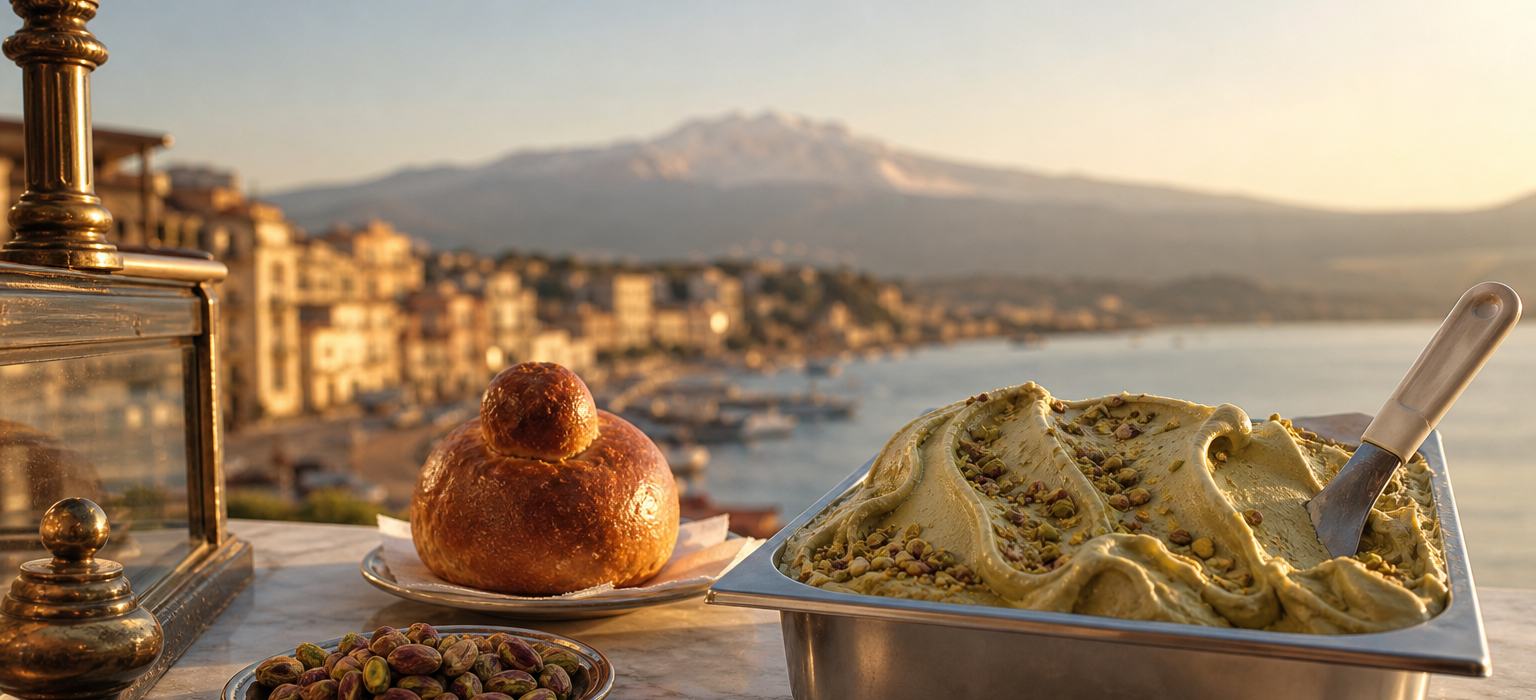
Almond granita and a brioche col tuppo: in Sicily gelato opens the day rather than closing it. It is the only region where the counter competes with the bar over the morning ritual.
Grown on the lava fields of Etna and harvested in alternate years, the Pistacchio Verde di Bronte DOP is the most precious ingredient in Italian gelato-making: the flavour that on its own justifies a journey.
It was the Arabs, around the ninth century, who brought sherbet to Sicily along with the art of storing Etna's snows in ice houses: from that encounter began the road that leads to the modern sorbet.
Gelato's Roots Run Deep Here: Arab Sorbet, Snow Pits and Granita
Sicily's tradition of frozen sweets predates that of the rest of Italy by centuries. Between the 9th and 11th centuries, the Arabs brought sherbet to the island, an iced drink made from fruit juices and sugar, along with the sugar cane and citrus that became its raw materials. Snow gathered on Etna and in the mountains was packed into snow pits — cavities and structures insulated with straw — and sold in summer to cool syrups and juices: from that practice descends the sorbet, and from the sorbet the granita.
Sicilian granita remains the most direct descendant of that history. It is not a gelato and it is not shaved ice: its fine, creamy texture comes from slow churning, without incorporating air as gelato does. Almond, lemon, black mulberry, coffee and pistachio are the canonical flavors, with strong local variations between the eastern and western coasts. Anyone who wants to understand Sicilian gelato-making should start here: first a well-made granita, then everything else in the display case.
Sicilian granita remains the most direct descendant of that history
Bronte Pistachio and the Brioche col Tuppo: The Symbols of Sicilian Gelaterie
If granita is the root, pistachio is the flag. The green Bronte pistachio DOP, grown on the lava fields on the slopes of Etna, is among the most imitated Italian ingredients in the world: production is limited, the harvest happens in alternate years and the price is high. That is why a pistachio gelato sold everywhere at rock-bottom prices is unlikely to contain Bronte DOP. Color helps you judge: real pistachio gives a muted green cream shading toward brown, never bright green. Serious workshops declare the origin at the counter, and the designation is protected.
The other symbol is a gesture: the brioche col tuppo, the soft leavened bun with the little topknot, which in Sicily accompanies granita and gelato from breakfast onward. Gelato in a brioche is not a tourist snack but a daily habit, especially in summer and especially in the east, between Catania and Messina. Ordering a brioche with almond-and-coffee granita in the morning remains one of the most authentic ways to eat Sicilian without sitting down to a meal.
That is why a pistachio gelato sold everywhere at rock-bottom prices is unlikely to contain Bronte DOP
Gelaterie in Sicily City by City: Palermo, Catania and Messina
The three main cities account for the largest share of the 263 Sicilian gelaterie catalogued by the guide. Palermo spreads its counters among the historic markets, the center around the Quattro Canti and the neighborhoods along the coast, from Mondello to the Kalsa: here the gelato tradition lives alongside the city's formidable pastry culture, and it is not unusual for the same workshop to do both well.
Catania is the city of pistachio and almond granita: the closeness of Bronte shows at the counters, and breakfast with granita and brioche is a rite the Catanese defend with pride, from Via Etnea to the streets around the fish market. Messina keeps a tradition of its own with coffee granita and cream, often served with the whipped cream both underneath and on top, and benefits from the constant flow of travelers across the Strait. Anyone crossing eastern Sicily in summer can build an entire itinerary simply by alternating granite and cones between these two cities.
Anyone crossing eastern Sicily in summer can build an entire itinerary simply by alternating granite and cones between these two cities
From Syracuse to Trapani and Ragusa: Gelato in the Provinces
Beyond the three big cities, the map of gelaterie in Sicily holds stops worth the detour. Syracuse pairs the island of Ortigia, where gelato accompanies the stroll between the Duomo and the Fountain of Arethusa, with the modern districts frequented by residents. Trapani looks west, between the salt pans and the sea, with a tradition of almond and citrus that reflects the surrounding countryside. Ragusa and its baroque, with Ibla at its head, offer counters that work extensively with the produce of the Hyblaean hills, from honey to milk from the local farms.
The same method applies across all these pages: the addresses come from public sources, are verified by the editorial team before publication and updated periodically, with closed businesses removed. No workshop pays to be in the guide and there are no sponsored positions. The rankings are not for sale, and when a gelateria appears at the top of a page it is an editorial choice, not an advertisement. For addresses and opening hours of Sicily's artisanal gelaterie, the individual city pages are the reference.
Trapani looks west, between the salt pans and the sea, with a tradition of almond and citrus that reflects the surrounding countryside
From the Strait Northward: Calabria, Campania and Sardinia
Sicily's culture of frozen sweets does not stop at the Strait. Heading up the peninsula, you find in Calabria a sister tradition, starting with Pizzo and its celebrated tartufo gelato, and continue naturally toward the gelaterie of Campania, where the Sorrento lemon plays the role that in Bronte belongs to the pistachio. Sardinia deserves a page of its own too, an island that, like Sicily, turns almonds, citrus and local milk into gelato.
For those staying on the island, the editorial team's advice is to use the seasons as a compass. Granita is at its best from May to September, when mulberries and lemons are in full swing; pistachio has no season but should be sought where the origin is declared; autumn is the time of the new almond crop. And if the trip allows for only one Sicilian breakfast, let it be in Catania, with a brioche col tuppo and an almond granita still cold in the early morning.
Sardinia deserves a page of its own too, an island that, like Sicily, turns almonds, citrus and local milk into gelato
The listings
The gelaterie of Sicily, town by town
Palermo(17)
Catania(3)
Modica(2)
Capo d'Orlando(1)
Casteldaccia(1)
Castellammare del Golfo(1)
Giardini-Naxos(1)
Licata(1)
Paceco(1)
Partanna(1)
San Vito Lo Capo(1)
Scicli(1)
Terrasini(1)
Villafranca Tirrena(1)
Other towns(220)
Show 212 more in Other towns
FAQ
Gelato in Sicily: quick answers
What is the typical flavor of Sicilian gelato-making?
Pistachio, in its finest version tied to the green Bronte pistachio DOP grown on the slopes of Etna. Alongside pistachio, the island's tradition lives on almond, lemon, black mulberry and coffee, the same flavors that define the classic Sicilian granita.
What is the difference between granita and gelato in Sicily?
Granita incorporates no air during churning and contains no milk in most of the classic flavors: the result is a fine, creamy texture, different from both gelato and shaved ice. In Sicily it is a product in its own right, with a standing equal to gelato's and a starring role at breakfast.
What is the brioche col tuppo and how is it eaten with gelato?
It is the soft Sicilian brioche with the characteristic little topknot, the tuppo. It is served with granita, for dunking, or split and filled with gelato. In eastern Sicily it is an ordinary breakfast, not an exception: almond, and coffee with whipped cream, are the best-loved pairings between Catania and Messina.
How do you recognize real Bronte pistachio at a gelateria?
By the color and by the transparency of the counter: authentic pistachio cream is a muted green shading toward brown, never bright green, and serious workshops declare the DOP origin in writing. Bronte's production is limited and expensive, so a cheap, ubiquitous pistachio is unlikely to be the real thing.
What is the best time of year for a gelato tour of Sicily?
From May to September, when granita is in high season and mulberries, lemons and peaches arrive ripe at the counters. Art cities like Syracuse and Ragusa remain pleasant into autumn, when the workshops process the new almond crop and the streets of Ortigia empty of the summer crowds.