Artisanal gelaterie
Artisanal Gelaterie of Tuscany: The Guide and History of Gelato from Florence to Siena
Symbol flavor: cantuccino — 470 gelaterie, town by town, with maps and verified listings.
The guide
Few regions can tell the story of gelato from so far back. According to Florentine tradition, it was at the court of the Medici that the Renaissance sorbet took the path that would turn it into modern gelato, and Florence has claimed that primacy for centuries, with specific names and stories handed down. The guide catalogues 470 gelaterie in Tuscany, spread across Florence, Siena, Pisa, Lucca, Livorno and Arezzo. This page begins with the history, because in Tuscany history is still written on the counters, from the Buontalenti flavor on down, and continues with the cities, the editorial method and the flavors worth seeking out, cantuccino included.
According to Florentine tradition, it was Bernardo Buontalenti who served the Medici court a frozen cream of milk, honey and egg yolks: today the "Buontalenti" flavour is the tribute Florence's gelaterie hand down to their presumed inventor.
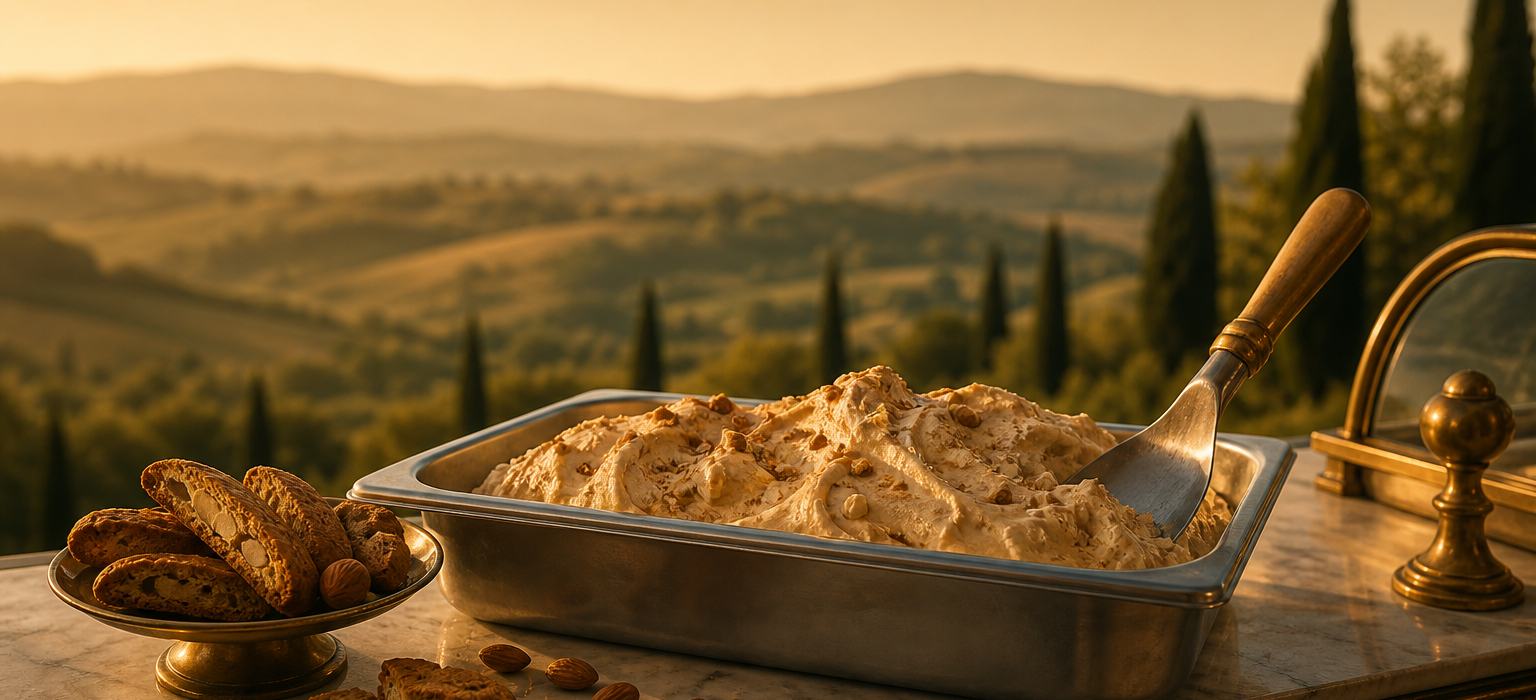
Prato's biscuit, born for Vin Santo, becomes an amber cream studded with almonds in the carapina: the "cantuccino" flavour is Tuscany in a single scoop.
Florence, Siena, Pisa, Lucca: few regions offer so many counters a step away from masterpieces. The cone in front of the Duomo is a tourist rite, but Florentines know the best workshops are often one street further on.
Ruggeri, Buontalenti and the Florence That Claims Gelato
Florentine tradition tells two stories, both set in the Medici Cinquecento. The first stars Ruggeri, a poultry seller who, as the story handed down has it, won a cooking contest at the Medici court with an iced sorbet, so admired that it followed Catherine de' Medici all the way to France. The second concerns Bernardo Buontalenti, court architect and stage designer, to whom tradition attributes a frozen cream of milk, honey and egg yolk prepared for the grand-ducal banquets: from him the Buontalenti flavor takes its name, a rich cream that Florentine gelaterie still serve today as a tribute.
How much is documented and how much is legend is a matter for historians, and the editorial team prefers to present both accounts for what they are: deeply rooted traditions, not birth certificates. One fact remains verifiable at the counters: Florence treats gelato as part of its identity, and the Buontalenti flavor is the most direct way to taste that claim. Anyone arriving in the city for the first time should start there.
Anyone arriving in the city for the first time should start there
From the Medici Counter to the Cantuccino: The Flavors of Today's Tuscany
The historical legacy translates into a very lively contemporary scene, one that over recent decades has made Tuscany one of the Italian territories richest in quality artisanal gelaterie. Alongside the Buontalenti, Tuscan counters handle cream flavors well in general, from zabaione to fior di panna, along with fruit from the countryside, with the season dictating the menu.
The flavor this guide has chosen as the regional emblem, however, is the cantuccino: the meeting of gelato and the almond biscuit of the Prato tradition, often rounded off with a nod to the vin santo that cantucci are dipped in at the end of a meal. It is a flavor that tells the region's story better than many words, because it brings together toasted almond, cream and that thoroughly Tuscan gesture of dunking the biscuit. Not every workshop offers it and the interpretations vary widely, from coarse crumbs in the cream to more elaborate versions: that very variety makes it a good proving ground. Where you find it made with care, you can trust the rest of the display case too.
Where you find it made with care, you can trust the rest of the display case too
Gelaterie in Tuscany City by City: Florence, Siena and Pisa
Florence leads the regional list for number of shops, with a remarkable concentration between the historic center and the Oltrarno: from the Duomo to Santo Spirito gelato is everywhere, which makes selection more necessary here than anywhere else. The rule applies in this city more than in any other in the guide: display cases with colorful mountains at the points of heaviest tourist traffic rarely reward you, while the workshops that keep their gelato covered in carapine and change their menu with the seasons deserve the detour of a few alleys.
Siena offers a more intimate scene, in keeping with its medieval center: gelato accompanies the walk between Piazza del Campo and the Duomo, with workshops serving tourists and university students alike. Pisa lives a double life: the crowds of Piazza dei Miracoli on one side, the university city along the Lungarni and Borgo Stretto on the other, and it is in the latter that the addresses frequented by the Pisans are hidden. In all three cities spring is the best moment, when the first strawberries join the menu and the streets are not yet full.
In all three cities spring is the best moment, when the first strawberries join the menu and the streets are not yet full
Lucca, Livorno and Arezzo: Tuscany Beyond the Best-Trodden Paths
Outside the most visited triangle, Tuscan gelaterie tell the story of a less crowded and often more genuine region. Lucca pairs the elegance of its center enclosed by the walls with the stroll along the tree-lined ramparts, where the cone is a ritual for Lucchese families even before it is one for visitors; the nearness of Versilia also brings the seaside habit of the evening gelato into town. Livorno is the most down-to-earth stop on the list, with its port-town soul: here gelato is eaten on the Terrazza Mascagni looking out to sea, and the counters work for a local public that forgives nothing.
Arezzo rounds out the list with its double nature as an art city and a hard-working provincial town: the evening stroll between Corso Italia and Piazza Grande sustains a scene of solid workshops, frequented above all by the Aretines. For anyone building an itinerary, these three cities hold a concrete advantage over the bigger destinations: shorter queues, more honest prices and gelato makers with the time to tell you what is in the carapina. The average quality, as so often happens away from the crowds, benefits accordingly.
The average quality, as so often happens away from the crowds, benefits accordingly
The Method Behind the Guide to Tuscan Artisanal Gelaterie
The 472 Tuscan addresses on the site come from public sources: chamber of commerce registers, the businesses' official channels, verifiable tips. The editorial team checks every entry before publication and revisits the lists at regular intervals, correcting hours and addresses and removing closed businesses; in a region with tourist turnover as high as this one, the periodic updating is the most demanding part of the work. No gelateria pays to appear in the guide and no position is sponsored: the highlights on the city pages are editorial choices.
A practical tip for using the guide on the ground: in Tuscany the line between an artisanal workshop and a reseller is less visible than elsewhere, because even the industrial chains have learned the aesthetics of wood and hand-written chalkboards. The reliable signals remain the usual ones: a short, seasonal menu, natural colors, a muted rather than bright pistachio, gelato sitting low in the carapina. And a direct question at the counter about where the gelato is made: those who make it in the back room are glad to answer.
No gelateria pays to appear in the guide and no position is sponsored: the highlights on the city pages are editorial choices
Open Borders: Liguria, Emilia-Romagna and Umbria
Tuscany's position makes it a natural crossroads for anyone exploring Italian gelato. To the northwest, the gelaterie of Liguria add basil, riviera lemons and focaccia on the side; to the northeast, Emilia-Romagna brings its culture of milk and pasta-making, with one of the densest gelato scenes in the country. To the southeast, Umbria offers a compact itinerary of hill towns and Apennine hazelnuts. Anyone who has already explored Tuscany's artisanal gelaterie will find in all three a natural second chapter of the journey.
The best way to close the circle, though, remains Florentine: return to the Oltrarno in the late afternoon, when the counters display the last carapine of the day, and order a Buontalenti next to a cantuccino. In the first is the legend of the Medici court, in the second the biscuit from Prato that the whole region has been dipping in vin santo for generations. Two flavors, four centuries apart, the same counter: hard to tell Tuscany's story better than that.
To the southeast, Umbria offers a compact itinerary of hill towns and Apennine hazelnuts
The listings
The gelaterie of Tuscany, town by town
Firenze(39)
Show 31 more in Firenze
Siena(18)
Show 10 more in Siena
Follonica(16)
Pisa(10)
Show 2 more in Pisa
Viareggio(6)
Carrara(4)
Empoli(4)
Grosseto(4)
Agliana(3)
Cecina(3)
Livorno(3)
Lucca(3)
Pontedera(3)
Porto Santo Stefano(3)
Prato(3)
Pistoia(2)
Porto Azzurro(2)
San Gimignano(2)
Albinia(1)
Aulla(1)
Buonconvento(1)
Campi Bisenzio(1)
Campo nell'Elba(1)
Castellina in Chianti(1)
Castiglione della Pescaia(1)
Cerreto Guidi(1)
Colle di Val d'Elsa(1)
Figline Valdarno(1)
Forte dei Marmi(1)
Ginestra Fiorentina(1)
Impruneta(1)
Isola Del Giglio(1)
Loro Ciuffenna(1)
Marina di Campo(1)
Montalcino(1)
Montepulciano(1)
Monteroni d'Arbia(1)
Ponte a Poppi(1)
Ponte Buggianese(1)
Ponticino(1)
Porto azzurro(1)
Pratovecchio Stia(1)
Reggello(1)
Rio Marina(1)
Rosignano Marittimo LI(1)
Rosignano Solvay(1)
San Casciano in Val di Pesa(1)
San Giovanni Valdarno(1)
San Macario in Piano(1)
San Quirico d'Orcia(1)
Terranuova Bracciolini(1)
Vaiano(1)
Vicopisano(1)
Other towns(285)
Show 277 more in Other towns
FAQ
Gelato in Tuscany: quick answers
Was gelato really invented in Florence?
Florence stakes its claim through two sixteenth-century traditions: Ruggeri's sorbet, which the story says won a Medici contest, and the frozen cream attributed to Bernardo Buontalenti. These are handed-down traditions rather than certified facts, but the bond between the city and gelato is old and firmly rooted.
What flavor is the Buontalenti?
It is a rich cream of milk, heavy cream and egg yolk, which Florentine gelaterie dedicate to Bernardo Buontalenti, the Medici architect credited by tradition with a frozen cream for the court banquets. Each workshop keeps its own version: tasting it in Florence is the most direct way to meet the local history.
What is in cantuccino gelato?
The versions vary, but the idea is constant: a cream that incorporates cantucci, the almond biscuits of the Prato tradition, often with a nod to the vin santo that accompanies them at the end of a meal. Crumbs, whole pieces or biscuit folded through the base: every Tuscan gelateria interprets it in its own way.
How many artisanal gelaterie are there in Tuscany?
The guide catalogues 470 gelaterie in Tuscany, the second-highest number among the regions on the site. Florence holds the largest share of shops, followed by Siena, Pisa, Lucca, Livorno and Arezzo, with a widespread presence in the smaller towns and along the coast as well.
Which Tuscan cities deserve a stop beyond Florence?
Lucca, for a cone on the tree-lined walls; Livorno, for gelato on the Terrazza Mascagni facing the sea; Arezzo, for the compact scene between Corso Italia and Piazza Grande. These are cities with fewer tourist crowds, more honest prices and workshops that work mainly for a local public, especially in spring.