Artisanal gelaterie
The Best Artisanal Gelaterie in Umbria: From Perugia to Orvieto in the Name of Dark Chocolate
Symbol flavor: dark chocolate — 58 gelaterie, town by town, with maps and verified listings.
The guide
In Umbria, gelato speaks the language of chocolate. That is no tourist-brochure exaggeration: Perugia has a chocolate-making tradition documented for over a century and hosts Eurochocolate every autumn, one of Europe's best-known events dedicated to cocoa. This culture flows straight into the counters of the 60 artisanal gelaterie catalogued in the region, where dark chocolate, the emblem flavor chosen for this page, is often the yardstick by which regular customers judge a workshop. The guide that follows starts from the ingredient, as the territory demands, and works its way to the addresses: Perugia first, then Assisi, Terni and Orvieto, each with its own way of understanding the cone.
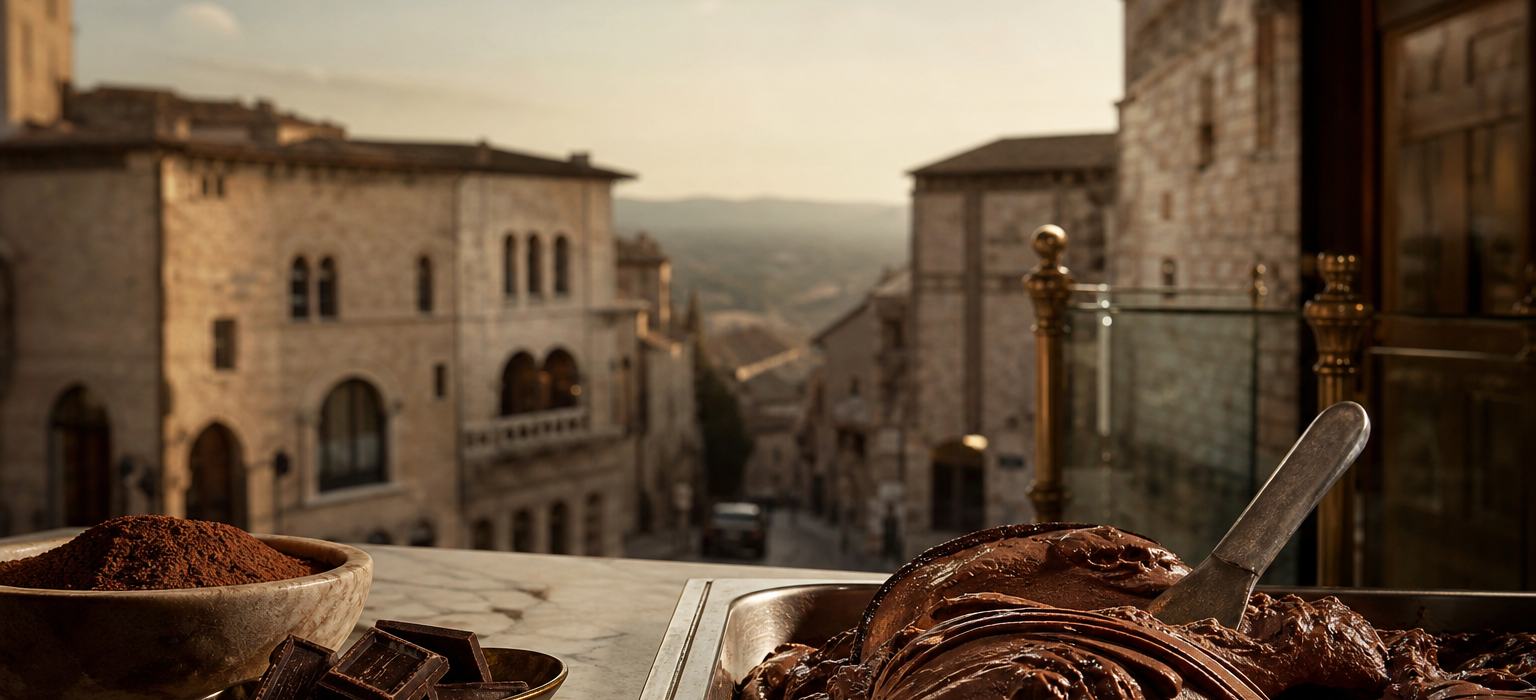
From Perugina in 1907 to Eurochocolate, Perugia has built an entire identity around cocoa: it was inevitable that dark chocolate would become the signature flavour of its counters.
A well-churned dark chocolate — bitter, dense, with no waxiness — is the ultimate test of an Umbrian workshop: here the public judges it with the severity of people who truly know their chocolate.
Between Norcia and Spoleto, the odd gelato maker dares a black truffle gelato, usually on a honey or cream base: a curiosity to taste rather than a classic, but it captures the region's spirit well.
Chocolate Above All: Perugia's Legacy
Few Italian cities have a bond with cocoa comparable to Perugia's. The city's industrial and artisanal chocolate tradition has produced masters, workshops and a demanding public over time, and Eurochocolate has turned this heritage into an international event that brings hundreds of thousands of visitors into the historic center every autumn. For gelato the consequences are concrete: an Umbrian gelato maker offering a mediocre dark chocolate is playing an away game on the home turf of people who genuinely know their chocolate.
The dark chocolate of Umbria's best gelaterie can be recognized by three traits: a color that is dark but not artificial, a clean bitterness balanced by measured sweetness, and a texture that stays creamy despite the cocoa percentage. Cocoa, it should be said honestly, does not grow in Umbria: the local tradition lies in the processing, the selection of origins and the maker's hand, not in the agricultural raw material. It is a distinction that serious workshops draw themselves, stating the provenance and percentage of the cocoa used in the recipe, and one that helps separate those who work chocolate from those who merely melt it.
Dark Chocolate and Hazelnut, the Pair That Rules the Umbrian Counter
Alongside dark chocolate, the second pillar of Umbrian counters is hazelnut. The pairing is no accident: chocolate and hazelnut share the same clientele, the same fat-balancing techniques and the same severity of judgment. A workshop that excels at one of the two flavors almost always excels at the other, because both punish shortcuts: industrial pastes loaded with flavorings give themselves away at the first taste, especially if the comparison with a version made from pure pastes is fresh in the memory.
Tasting dark chocolate and hazelnut in sequence at the same gelateria gives you a reliable X-ray of the workshop in a few minutes. The signature test, common in many of Umbria's artisanal gelaterie, is the flavor that unites them: the bacio, a frozen variation on the chocolate-and-hazelnut pairing that carries particular meaning in Perugia. No invention is needed here: local history has already written the combination, and the gelato maker's job is not to betray it. A practical tip for the first tasting: a small cone, two flavors, no whipped cream on top, so that neither taste covers the other.
The pairing is no accident: chocolate and hazelnut share the same clientele, the same fat-balancing techniques and the same severity of judgment
Artisanal Gelaterie in Umbria: 58 Addresses from Perugia to Orvieto
The 60 artisanal gelaterie catalogued in Umbria are spread along the axis that holds the two provinces together. Perugia leads for number of workshops, with a scene that combines historic addresses in the center and new openings in the outer districts: the acropolis, with Corso Vannucci as its natural promenade, is the most logical starting point. Assisi lives on a different public, made up of pilgrims and international tourism: here gelato is a pause between one basilica and the next, and the workshops of the historic center handle flows heavily concentrated in the months from April to October. Terni, the region's second city, has a more everyday, less touristy scene, where gelaterie are judged on the loyalty of residents rather than on passing trade. Orvieto closes the list of main cities with its clifftop perch: riding the funicular up and ending the tour of the Duomo with a cone is a well-established habit among the city's visitors.
Four different settings, one standard: an in-house workshop, artisanal production, declared flavors. That is the thread that ties together the Umbrian gelaterie in this guide.
Four different settings, one standard: an in-house workshop, artisanal production, declared flavors
How the Editorial Team Selects Umbria's Gelaterie
The Umbrian entries on appgelato.it are built from public data: business registers, the workshops' official websites and channels, verifiable tips. The editorial team checks that every address corresponds to genuinely artisanal production and updates the list whenever a business closes, changes its name or moves its workshop. No gelateria can pay to enter the guide or to climb positions: the regional pages carry no sponsored rankings and the order of presentation has no commercial value. The aim is for the list of Umbria's artisanal gelaterie to reflect the real state of the scene, not an aged photograph of it.
The Umbrian count, 58 addresses, places the region halfway between the small territories of the center-south and the big tourist regions. It is a sample large enough to offer alternatives in every main city, yet contained enough to let the editorial team run precise checks. Updates are concentrated twice a year, before the summer season and in autumn, when Eurochocolate turns attention back to Perugian chocolate and, with it, brings new tips from readers. Anyone who spots outdated information in an Umbrian entry can write to the editorial team, which verifies and corrects it promptly.
The aim is for the list of Umbria's artisanal gelaterie to reflect the real state of the scene, not an aged photograph of it
Beyond Umbria's Borders: Tuscany, the Marche and Lazio
Umbria is the only peninsular region without a coastline, surrounded by territories with very different gelato traditions. To the west, the gelaterie of Tuscany play in an entirely different league of volume and variety, between Florence and the coast. To the east, the Marche take gelato to the seaside, with an Adriatic seasonality Umbria does not know. To the south, Lazio and the Roman scene set the most demanding benchmark in central Italy.
For travelers, the border is an opportunity: from Orvieto you cross into Lazio in a few kilometers, and from Perugia Tuscany is half an hour away. Comparing a Perugian dark chocolate with a Roman one over the same weekend is an exercise the editorial team often recommends, because it shows how much the same flavor changes from one school to another: cocoa percentages, sweetness, serving temperature, everything diverges. Chocolate remains the calling card with which Umbria enters that comparison.
To the west, the gelaterie of Tuscany play in an entirely different league of volume and variety, between Florence and the coast
The listings
The gelaterie of Umbria, town by town
Perugia(7)
Castiglione del Lago(1)
Foligno(1)
Orvieto(1)
San Gemini(1)
Santa Maria degli Angeli(1)
Selci Lama(1)
Spoleto(1)
Other towns(36)
Show 28 more in Other towns
FAQ
Gelato in Umbria: quick answers
How many artisanal gelaterie are there in Umbria?
The guide catalogues 60 artisanal gelaterie in Umbria. Perugia holds the largest number of workshops, followed by Terni; Assisi and Orvieto complete the picture of the cities with the most addresses. The list is reviewed by the editorial team at regular intervals, with the main updates before summer and in autumn.
Why is dark chocolate Umbria's emblem flavor?
Because of Perugia's chocolate-making tradition, documented for over a century and celebrated every autumn by Eurochocolate. This culture has shaped a public that is demanding about cocoa, and dark chocolate has become the flavor by which Umbrian workshops measure themselves. A good dark chocolate, in Umbria more than anywhere, is considered the gelato maker's signature.
Is the cocoa in Umbrian gelato produced locally?
No, cocoa does not grow in Umbria: it is imported, as everywhere in Italy. The Umbrian tradition concerns the working of chocolate, not its cultivation. The most serious workshops declare the origin and percentage of the cocoa they use, useful information for telling those who select their raw material from those who use generic preparations.
Where should you look for a gelateria in Assisi or Orvieto?
In both cities the artisanal workshops are concentrated in the historic center, along the routes most walked by visitors: the axis of the basilicas in Assisi, the Duomo area in Orvieto. In the months from April to October it is worth counting on extended evening hours, while in winter several businesses cut back their openings and their display.
Does Eurochocolate have an effect on Perugia's gelaterie?
Yes, indirect but real. The event brings the city a public interested in cocoa even outside the gelato season, and many workshops take the opportunity to offer dark chocolates of different origins or themed pairings. For anyone visiting Perugia in autumn, it is one of the best moments to judge the local chocolate scene as a whole.