Artisanal gelaterie
Artisanal Gelaterie in Piedmont: The Complete Guide to Gianduia and Hazelnut
Symbol flavor: gianduia — 453 gelaterie, town by town, with maps and verified listings.
The guide
Piedmont is the region where gelato meets its most celebrated raw ingredient: the hazelnut. With 453 gelaterie catalogued in this guide, from Turin's historic cafés to the workshops of the Langhe, the territory offers a density of artisanal counters that few other parts of Italy can match. The flavor chosen as the emblem of Piedmont's gelaterie is gianduia, born from the union of cocoa and roasted hazelnuts and still the yardstick by which the seriousness of a workshop is measured. In these pages you will find the cities with the most shops, the criteria for recognizing genuinely artisanal gelato, and some useful pointers for planning tastings throughout the year.
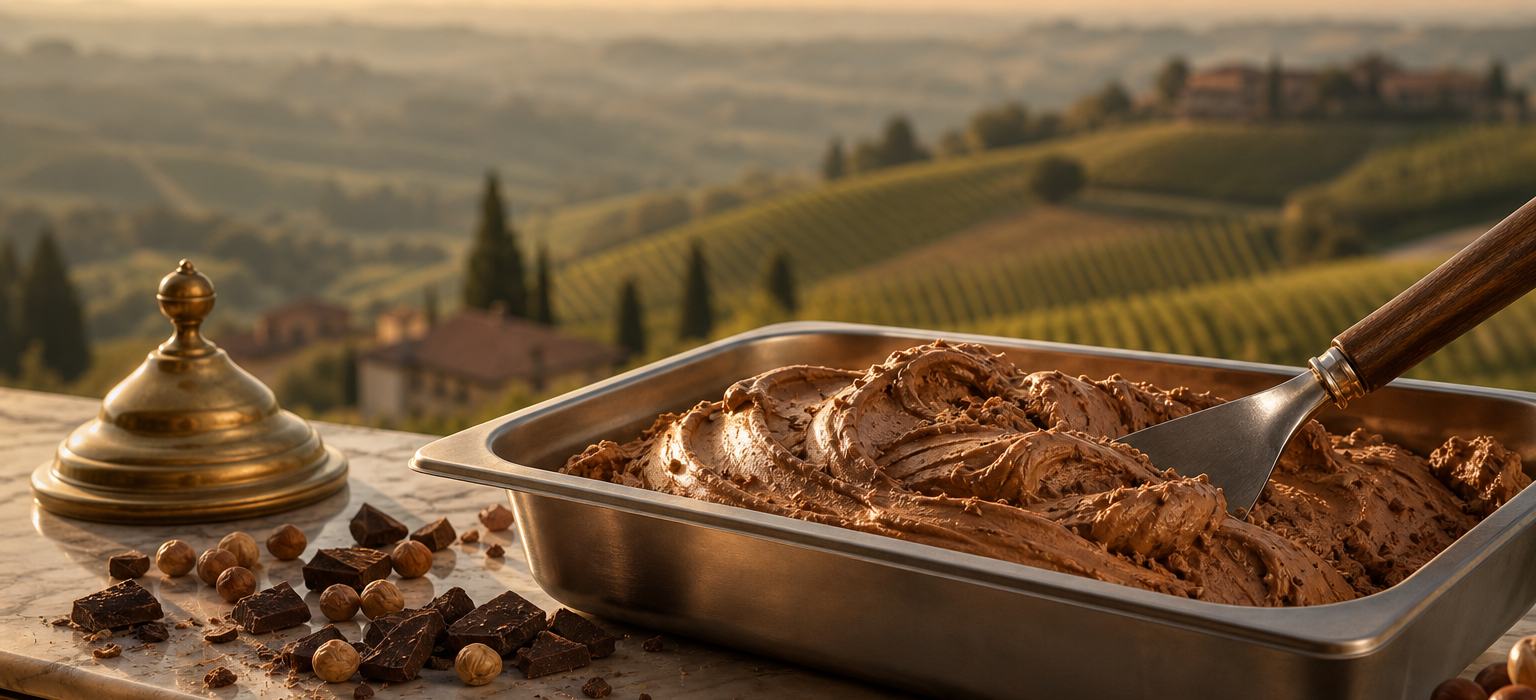
According to Turin tradition, gianduia was born when the Napoleonic blockade made cocoa scarce and chocolatiers stretched it with hazelnuts from the Langhe. From stopgap to source of pride: today it is the region's signature flavour.
The Nocciola Piemonte IGP, the "tonda gentile trilobata", is considered among the world's finest hazelnuts for pastry work: at the gelateria you recognise it by its warm colour and a long finish with no bitterness.
Turin is a city of nineteenth-century cafés and regal afternoon treats: the bicerin — coffee, chocolate and cream — long ago found its translation into the carapina.
The Piedmont IGP Hazelnut, Where Everything Begins
Before the gelato comes the ingredient. The Piedmont IGP hazelnut, grown mainly across the Langhe, Roero and Monferrato, is considered among the best in the world for its aromatic yield after roasting: intense fragrance, clean sweetness, no lingering bitter note. For a gelato maker this translates into a hazelnut paste that needs no added flavorings to fill the cone with taste.
When you walk into one of Piedmont's gelaterie, the hazelnut flavor is the first test. The color should be muted, somewhere between beige and dove grey: a very pale or overly bright cream often points to a low percentage of real nuts. The price of the raw material is an honest clue too: IGP hazelnuts are expensive, and a workshop that genuinely uses them tends to say so on the label or on the flavor card. Asking where the hazelnut paste comes from is not pedantry; it is the quickest way to understand who you are dealing with.
For a gelato maker this translates into a hazelnut paste that needs no added flavorings to fill the cone with taste
Gianduia, from Turin to the Cone
Gianduia was born in Turin as a blend of cocoa and hazelnuts, an ingenious solution by Piedmontese chocolatiers that went on to become the identity of an entire city. From the gianduiotto chocolate to gelato is a short step, and today almost every serious workshop in the region offers its own version: some keep it darker and more cocoa-forward, others push the hazelnut until it verges on praline.
Turin's gelato culture is interwoven with that of the historic cafés of the city center, where the tradition of hot chocolate and the bicerin has schooled generations of local palates in the pairing of cocoa and hazelnut. It is a context that explains why, in Turin, gianduia eaten on the go is judged with almost sporting severity. If you visit the city, it is worth tasting the same flavor at two or three different shops on the same day: the differences in roasting and in the balance between gianduia's two souls come through immediately, and it is the most enjoyable way to form an opinion of your own.
It is a context that explains why, in Turin, gianduia eaten on the go is judged with almost sporting severity
Where the Gelaterie Are in Piedmont: The Cities with the Most Shops
Turin leads the regional ranking for number of gelaterie, as is natural for a city of its size and confectionery history. Alessandria and Cuneo follow, two very different provinces: the first a lowland crossroads between Piedmont, Liguria and Lombardy, the second the gateway to the Alpine valleys and the Langhe. Novara and Asti complete the group of cities with the highest concentration of shops, while Alba deserves a mention of its own: it is small, but its position in the heart of the hazelnut country makes it an almost obligatory stop for anyone wanting to taste the region's signature flavor just a few kilometers from the hazelnut groves.
For anyone planning an itinerary, the most sensible combination remains Turin plus a town in the Langhe: you go from urban gelato, heir to the café tradition, to provincial gelato, often tied more directly to the farming supply chain. Two faces of Piedmontese gelaterie that complement each other.
Two faces of Piedmontese gelaterie that complement each other
How the Artisanal Gelaterie of Piedmont Are Selected
The 453 addresses in this section come from public sources: chamber of commerce registers, the businesses' official websites and information that can be verified online. The editorial team checks the essential details, such as address and operating status, and updates them periodically, because the world of artisanal gelaterie in Piedmont is a lively one, with shops opening, closing and changing hands fairly often.
One point should be stated clearly: this guide carries no paid rankings. No gelateria can buy visibility or position, and the order in which the addresses appear reflects no commercial arrangement of any kind. If you come across outdated information, it is more likely the result of a recent change than of an editorial choice. The practical advice remains the usual one: before setting out for a specific workshop, check its up-to-date opening hours on the business's own channels, especially in the winter months, when many provincial gelaterie cut back their hours or close to focus on production.
One point should be stated clearly: this guide carries no paid rankings
From Piedmont to the Neighboring Regions
Anyone exploring Piedmont's gelaterie is well placed to widen the circle. To the south, beyond the Apennines, Liguria's coastal gelaterie offer an opposite and complementary tradition built on aromatic herbs and citrus, with basil as its banner. To the east, Lombardy has the densest urban scene in northern Italy, while to the north the small Aosta Valley concentrates just a handful of workshops, but in Alpine settings where a cone after a hike tastes altogether different.
Comparing regions is one of the most instructive exercises for gelato lovers: the same base cream changes character as you move from lowland milk to mountain milk, and fruit flavors follow the local farming calendars. Starting from Turin's gianduia and ending at Genoa's basil in a single weekend is a small education for the palate.
Starting from Turin's gianduia and ending at Genoa's basil in a single weekend is a small education for the palate
The listings
The gelaterie of Piedmont, town by town
Torino(45)
Show 37 more in Torino
Alessandria(11)
Show 3 more in Alessandria
Biella(6)
Bra(5)
Arona(4)
Asti(4)
Novara(4)
Pinerolo(4)
Verbania(4)
Acqui Terme(3)
Chieri(3)
Orta San Giulio(3)
Rivoli(3)
Susa(3)
Vercelli(3)
San Mauro Torinese(2)
Alagna Valsesia(1)
Alpignano(1)
Andezeno(1)
Arquata Scrivia(1)
Avigliana(1)
Borgofranco d'Ivrea(1)
Borgomanero(1)
Borgosesia(1)
Bussoleno(1)
Buttigliera Alta(1)
Candelo(1)
Cannero Riviera(1)
Caraglio(1)
Carema(1)
Carignano(1)
Castagneto Po(1)
Castellamonte(1)
Cavaglià(1)
Cavour(1)
Cuneo(1)
Donato(1)
Dormelletto(1)
Dronero(1)
Gassino Torinese(1)
Luserna San Giovanni(1)
Magliano Alfieri(1)
Massino Visconti(1)
Mazzè(1)
Montalenghe(1)
Orbassano(1)
Ormea(1)
Pragelato(1)
Racconigi(1)
Riva Presso Chieri(1)
Romagnano Sesia(1)
Rosta(1)
San Damiano d'Asti(1)
San Damiano D'Asti(1)
San Secondo di Pinerolo(1)
Settimo Torinese(1)
Settimo Vittone(1)
Tortona(1)
Valchiusa(1)
Varallo(1)
Vicolungo(1)
Villanova d'Asti(1)
Villar Focchiardo(1)
Other towns(281)
Show 273 more in Other towns
FAQ
Gelato in Piedmont: quick answers
What is the typical flavor of Piedmontese gelaterie?
Gianduia, followed closely by pure hazelnut. Both revolve around the Piedmont IGP hazelnut of the Langhe, Roero and Monferrato. A good Piedmontese workshop is judged first and foremost on these two flavors: if they convince, the rest of the counter usually does too.
How many artisanal gelaterie are there in Piedmont?
This guide catalogues 453 gelaterie across the region. The greatest concentration is in Turin, followed by Alessandria, Cuneo, Novara and Asti; Alba stands out relative to its size thanks to its proximity to the hazelnut-growing area.
Where is the best place to try gianduia gelato?
Turin remains the natural reference point, for its history and its number of shops. The interesting alternative is Alba, where the closeness of the hazelnut groves shows in the quality of the pastes used. Tasting the same flavor in several workshops in the same city helps you pick up the differences in roasting.
What sets the Piedmont IGP hazelnut apart from other hazelnuts?
Its aromatic yield after roasting: intense fragrance, clean sweetness and no lingering bitterness, plus a round shape that makes for even roasting. For gelato this means pastes that need no added flavorings, an advantage you can clearly taste on the spoon.
Are gelaterie in Piedmont open in winter too?
Many are, especially in Turin, where gelato coexists with the hot-chocolate season. In the provinces, several shops shorten their hours or close for a few weeks. It is best to check official channels before traveling; spring, when the workshops of the Langhe reopen, is the ideal moment to start again from Alba.