Artisanal gelaterie
Gelaterie in Lazio: Choosing the Best Artisanal Gelaterie in Rome and the Region's Other Cities
Symbol flavor: ricotta and sour cherry — 484 gelaterie, town by town, with maps and verified listings.
The guide
In Rome the problem is not finding a gelato: it is avoiding a bad one. In the streets between the Trevi Fountain and Piazza Navona, counters follow one another every few meters, and the difference between a serious workshop and a reseller of industrial mixes cannot be read from the sign, which almost always says the same thing. That is why the page dedicated to the 484 gelaterie in Lazio catalogued by this guide starts with the practical side: the concrete signals that set real artisanal gelato apart, as valid in the capital as in Tivoli, Latina, Civitavecchia, Viterbo and Frascati. Then come the most Roman flavor of all, ricotta e visciole (ricotta and sour cherry), the cities, and the method the editorial team uses to keep the listings up to date.
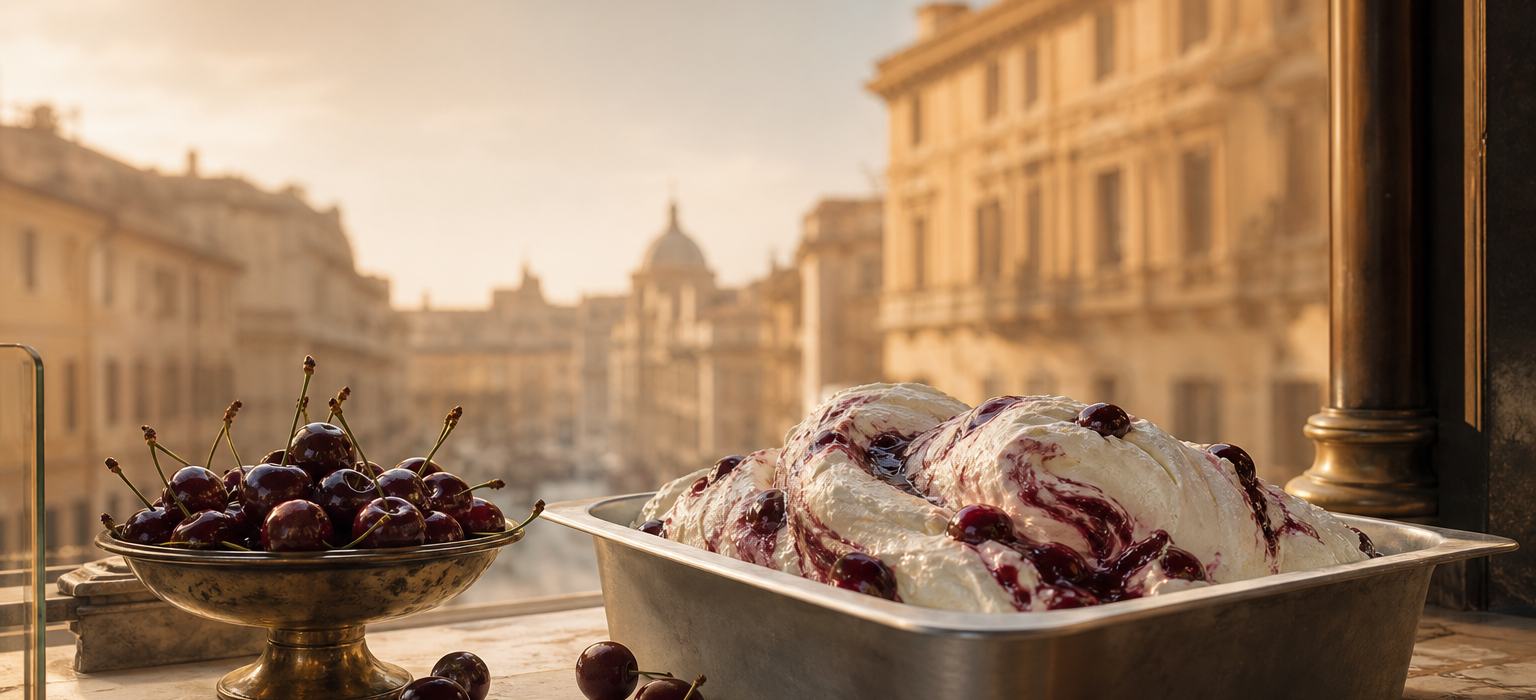
The pairing born in the bakeries of Rome's Jewish ghetto — ricotta and visciola sour cherries — moved to gelato without losing a thing: Ricotta Romana DOP provides the base, the sour cherries the contrast.
At the kiosks along the Tiber, ice is still shaved by hand from the block and drowned in syrups, just as a century ago: it is not gelato, but it is the working-class counterpart of the Roman carapina in summer.
In Nemi, in the Castelli Romani, wild strawberries are a local cult complete with their own festival: in the sorbets of the Castelli they are the right thing to taste in June.
How to recognize a true artisanal gelateria in Rome
The reliable signals are few and can be checked in thirty seconds, before even joining the line. The editorial team uses these four, in Rome as in the rest of Lazio:
- Covered carapine: lidded steel wells protect the gelato from light and temperature swings. The colorful mountains piled up in the display window are there to be photographed, not to keep the product well.
- Natural colors: pistachio is a muted green, banana leans toward pale grey, mint is white unless it has been colored. Brilliant shades mean food coloring.
- A seasonal list: strawberry in January is a warning. Serious workshops change flavors with the market, and a short list is almost always a good sign.
- Declared ingredients: shops that work well are glad to display the origin and composition of their main flavors.
No single signal is enough on its own, but three out of four rarely lie. In central Rome, where rent is paid with tourist volume, these criteria quickly rule out most of the shops pressed up against the monuments and reward those working a few streets away.
The colorful mountains piled up in the display window are there to be photographed, not to keep the product well
Ricotta e visciole, the flavor that tastes of Rome
Every region in this guide has a signature flavor, and for Lazio the choice fell on ricotta e visciole. The pairing comes from the pastry tradition of Jewish Rome: the ricotta and sour-cherry crostata of the Ghetto is one of the city's most identity-defining desserts, and Roman gelato making adopted it, turning it into a ricotta cream shot through with wild sour cherries in compote. The contrast between the barely sweet dairy base and the dark acidity of the visciole is about as Roman as anything that can go in a cone.
It is also a flavor that sorts the workshops. Real ricotta gives a slightly grainy cream that never cloys, a long way from anonymous white bases; visciole in compote have a deep red color and a tart edge, easy to tell apart from industrial sour-cherry syrup, which is sweet and uniform. Anyone who finds it on the list, made with care, has almost always found a good gelateria. Not every shop offers it year-round, and that is as it should be: visciole have a short season, between June and July, and the best workshops use compote prepared during that window.
The contrast between the barely sweet dairy base and the dark acidity of the visciole is about as Roman as anything that can go in a cone
Gelaterie in Rome: from the central rioni to the neighborhoods
Rome accounts for the large majority of the region's 484 addresses, with a scene best read zone by zone. The historic center offers the best and the worst within a few meters of each other: alongside counters designed for passing tourism, historic artisanal gelaterie survive, often family-run, that Romans have defended for generations. Rioni (central districts) like Monti and Trastevere alternate solid addresses with showy windows, and the four signals from the first section are the right tool for telling them apart on the spot.
The most interesting scene, though, is growing outside the center. Prati and the neighborhoods around the Vatican serve residents and office workers, San Giovanni and the Appio area have counters rooted in their neighborhoods, and eastern Rome has seen workshops open in recent years with a sharp eye for raw ingredients and seasonality, from Pigneto outward. Anyone staying in the center can count the metro ride as part of the price of a good cone: it is often worth more than the line in front of the city's most photographed counter.
The most interesting scene, though, is growing outside the center
Gelaterie in Lazio beyond Rome: Tivoli, Frascati, Viterbo, Latina and Civitavecchia
The rest of the region deserves more attention than it gets. Tivoli pairs its historic villas with a town promenade where gelato is an afternoon ritual, easy to combine with a visit to Villa d'Este. Frascati and the Castelli Romani have always been the Romans' classic day trip out of the city: here the cone accompanies the summer controra, the hot early-afternoon lull when the city heads for the hills in search of cool air, and the counters serve a public that comes back every weekend and forgives no slips.
Viterbo offers the medieval San Pellegrino quarter as a backdrop, with a compact scene and small-town prices; Latina serves a rich agricultural territory, with Pontine fruit entering the lists in the warm months; Civitavecchia catches the traffic from the port, but the workshops residents actually frequent sit along the main street, not opposite the boarding docks. In all these cities one simple rule applies: follow local hours. A counter that is busy at six on a Saturday evening, with locals rather than suitcases, is the most reliable review there is.
Tivoli pairs its historic villas with a town promenade where gelato is an afternoon ritual, easy to combine with a visit to Villa d'Este
Who verifies Lazio's artisanal gelaterie, and how
The regional listings are built from public sources: business registries, the shops' official sites and channels, documented reports. The editorial team verifies every entry before publication and updates the listings at regular intervals, correcting addresses and opening hours and removing businesses that have closed; on a pool as large as Rome's the review work never really ends, which is why the city pages show the date of the last check.
On independence the line is clear: no gelateria pays to be in the guide, no position is sponsored and editorial write-ups are not for sale. In a city where visibility along the tourist flows is worth a great deal, the point is far from minor: paid rankings are exactly the mechanism this guide wants to avoid. Anyone who finds a closed business or outdated information can report it through the site's contact channels: reader reports, once verified, enter the next update cycle.
On independence the line is clear: no gelateria pays to be in the guide, no position is sponsored and editorial write-ups are not for sale
From Lazio toward Tuscany, Umbria and Campania
Lazio's central position makes side trips into the neighboring regions natural. To the north, the gelaterie of Tuscany add the Florentine Buontalenti tradition and the cantuccino flavor to the journey; to the northeast, Umbria offers an itinerary through hill towns where gelato comes without lines; to the south, the gelaterie of Campania play the card of Sorrento IGP lemon and Giffoni hazelnut. The criteria on this page hold there too: artisanal gelaterie can be recognized by the same signals from Florence to Naples.
For those staying in Lazio, the final advice is about the calendar. The Roman spring, between April and May, is the perfect moment: strawberries enter the lists, the carapine fill with new flavors and the center does not yet have July's lines. And if the trip falls between June and July, there is only one question worth asking at the counter: whether the season's visciole have made it into the ricotta yet.
The criteria on this page hold there too: artisanal gelaterie can be recognized by the same signals from Florence to Naples
The listings
The gelaterie of Lazio, town by town
Roma(156)
Show 148 more in Roma
Tivoli(8)
Civitavecchia(5)
Latina(5)
Albano Laziale(4)
Frascati(4)
Aprilia(3)
Bracciano(3)
Valmontone(3)
Atina(2)
Fiano Romano(2)
Anguillara Sabazia(1)
Bolsena(1)
Borgo Grappa(1)
Cassino(1)
Castrocielo(1)
Cisterna di Latina(1)
Genzano di Roma(1)
Grottaferrata(1)
Ladispoli(1)
Lido di Ostia(1)
Minturno(1)
Montefiascone(1)
Monterotondo(1)
Poggio Bustone(1)
Poggio Mirteto(1)
Pomezia(1)
San Cesareo(1)
San Felice Circeo(1)
Subiaco(1)
Tarquinia(1)
Terracina(1)
Viterbo(1)
Other towns(259)
Show 251 more in Other towns
FAQ
Gelato in Lazio: quick answers
Why do covered carapine indicate good gelato?
Lidded steel wells keep the temperature constant and protect the gelato from light and air, conditions that preserve its structure and flavor. Display cases with colorful mountains favor visual effect over preservation: to hold up exposed like that, the product generally needs more air and stabilizers.
What is the ricotta e visciole flavor?
It is the gelato interpretation of a traditional Roman dessert, the ricotta and sour-cherry crostata of the Jewish Ghetto: a lightly sweetened ricotta cream shot through with a compote of tart wild sour cherries. The editorial team considers it the most representative flavor of Lazio's gelaterie.
How do you avoid the tourist gelaterie in central Rome?
By applying the guide's four signals: covered carapine, natural colors, a short seasonal list, declared ingredients. Right next to the most photographed monuments these criteria quickly rule out many shops; moving a few streets away, or taking the metro toward the neighborhoods, almost always improves the result.
How many gelaterie are there in Lazio?
The guide catalogues 484 gelaterie in Lazio, concentrated largely in Rome but also spread across Tivoli, Latina, Civitavecchia, Viterbo and Frascati. The listings are verified and updated periodically by the editorial team, with closed businesses removed in every review cycle.
Is it worth looking for artisanal gelato outside Rome?
Yes, and it often pays off: in Frascati and the Castelli Romani gelato is part of the Romans' classic day trip, Tivoli pairs it with the historic villas, Viterbo offers the medieval San Pellegrino quarter as a setting. Fewer lines, lower prices and counters that live on regulars, especially on summer evenings.