Artisanal gelaterie
The Complete Guide to Artisanal Gelaterie in Emilia-Romagna, from Bologna to the Riviera
Symbol flavor: crema (egg custard) — 542 gelaterie, town by town, with maps and verified listings.
The guide
There are regions where gelato is a pleasure and regions where it is serious business. Emilia-Romagna belongs to the second category: the same land that codified some of the world's most imitated filled pastas, cured meats and cheeses applies the same artisan rigor to gelato. The 542 gelaterie catalogued in this guide tell the story of a tradition that runs from the neighborhood counters of Bologna to the late-night display cases of the Rimini riviera. The signature flavor chosen for the region is crema (the classic egg-yolk custard flavor), the acid test of any gelato workshop: few ingredients, no tricks, and the gelato maker's skill in plain sight.
A stone's throw from Bologna, Carpigiani has been producing the world's most widely used gelato machines since the postwar years, and hosts the Gelato Museum: if artisanal gelato has an industrial capital, this is it.
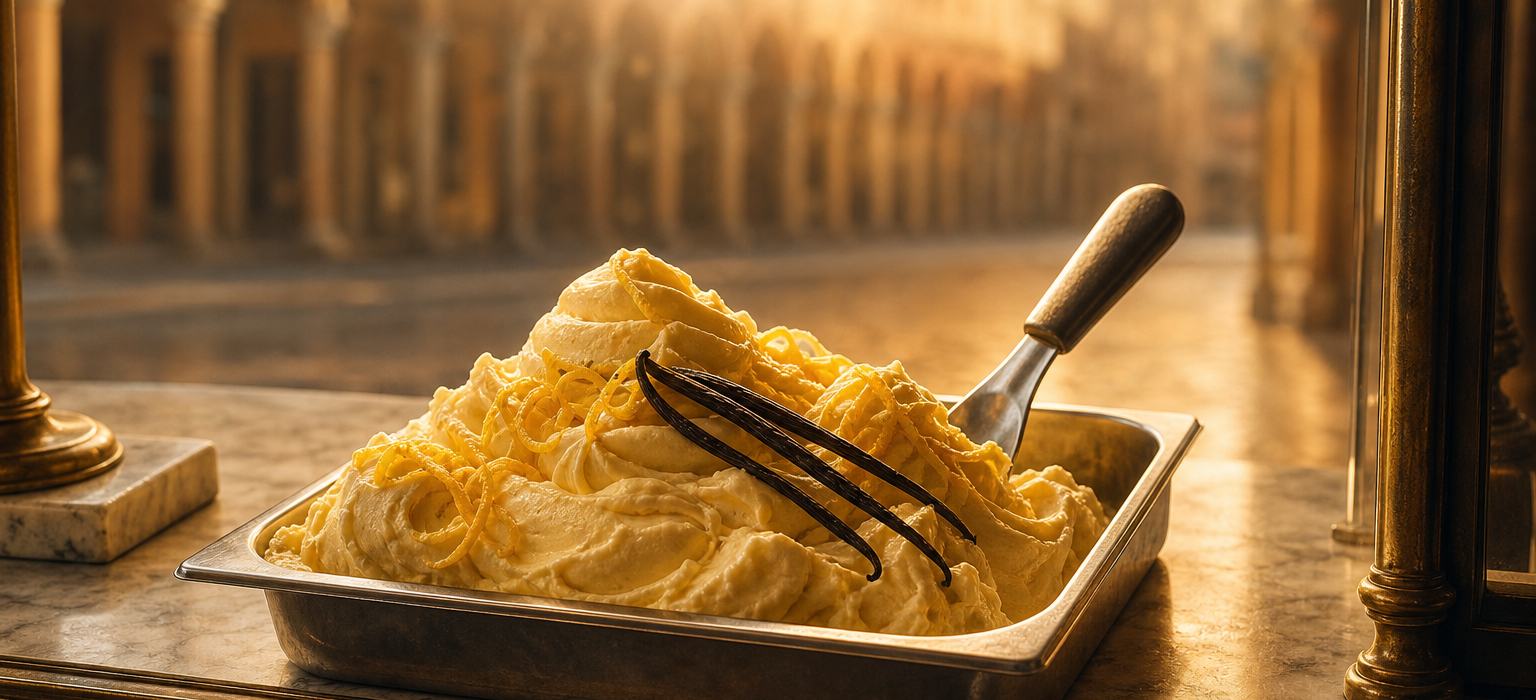
The egg custard cream — yolks, milk and lemon zest — is the yardstick by which a counter is judged in Emilia: if the crema is alive, the rest of the display case deserves your trust.
From Rimini to Milano Marittima, the Romagna riviera is the biggest summer training ground of Italian gelato: 500-plus counters serving an entire nation on holiday every season.
A land of artisans: why Emilia-Romagna's gelaterie start with an advantage
To understand the gelaterie of Emilia-Romagna, you have to start further back, with the region's material food culture. Here, transforming food has always been a precision trade: pasta dough rolled by hand, cured meats aged slowly, the long timelines of vinegar and cheese. Anyone who grows up inside this culture brings the same mindset to the gelato counter, one built on raw ingredients chosen with obsessive care and recipes tested to exhaustion.
The result shows in the density and average quality of what's on offer. In many Emilian cities the trusted gelateria is a neighborhood institution on par with the bakery, with customers who have been coming back for decades and judge every tweak to a recipe. It is a demanding audience that keeps the bar high and makes life hard for improvised counters. If you are looking for a territory where walking into a random gelateria carries little risk, the Via Emilia is probably the right place to try your luck.
The result shows in the density and average quality of what's on offer
Crema, the flavor that tells the region's story
Choosing crema as the symbol of Emilia-Romagna's gelaterie is no accident. In a land of milk, eggs and patience, crema is the flavor that allows no shortcuts: the base is stripped down to essentials, and any flaw in balance or ingredients surfaces at the first taste. The region's gelato makers know it and treat crema as their calling card.
For the taster, crema is also the most honest tool for comparing one counter with another. Elaborate flavors can hide a lot behind ripples and mix-ins; a crema cannot. The color should lean toward the pale yellow of real eggs, not a bright artificial yellow, and the texture should be silky without turning rubbery, a sign of too many thickeners. The editorial team's advice for a tasting tour of the region is simple: order crema at every gelateria you visit and use it as your yardstick. By the third city you will have developed a surprisingly reliable palate.
The region's gelato makers know it and treat crema as their calling card
Carpigiani and the Gelato Museum: technique speaks Bolognese
There is a technical reason the gelato world has looked to Bologna for decades: the Bologna area is where Carpigiani was born and still operates, the company that made gelato machines famous around the world, a fact so well known in the trade that it borders on proverbial. Around this industrial legacy grew the Gelato Museum, a space dedicated to the history, culture and technique of artisanal gelato, and a curious destination for food lovers and professionals alike.
This proximity between workshops and the equipment industry has concrete effects on the gelaterie of Emilia-Romagna: the region has always been a crossroads of professional training, drawing aspiring gelato makers from every continent. Many counters in the area are run by people who studied the craft systematically, not only through family tradition. For anyone visiting Bologna with a free afternoon, pairing a stop at the museum with a couple of tastings in the city center is an unusual, concrete way to understand what goes into a well-made tub.
Many counters in the area are run by people who studied the craft systematically, not only through family tradition
The Romagna riviera, summer training ground of the cone
If Bologna is the head, the riviera is the beating summer heart of the region's gelato. Between Rimini and Ravenna, from May to September, the walking cone is an integral part of the vacation ritual: an evening stroll along the seafront without gelato is considered, with some justification, incomplete. The sheer scale of beach tourism makes the coast one of Europe's most intense marketplaces for the artisanal gelaterie of Emilia-Romagna.
Volume like that produces everything, and this is exactly where selection matters. Alongside flashy operations built for passing tourist trade, historic workshops survive that have supplied vacationing families for generations, with children returning as adults to bring their own kids to the same counter. Spotting them is not hard: lines of regulars outside the peak tourist season, flavors that rotate with the fruit, and signs that need no neon to get noticed. The riviera rewards those who stay true to the craft, summer after summer.
The sheer scale of beach tourism makes the coast one of Europe's most intense marketplaces for the artisanal gelaterie of Emilia-Romagna
The gelato cities of Emilia-Romagna, from Parma to Ravenna
The geography of the region's gelato follows the Via Emilia and then bends toward the sea. Bologna leads in number of shops, as you would expect of the regional capital, followed by Rimini, where the figure reflects the seaside concentration. Modena and Parma, cities with famously strong gastronomic identities, maintain a solid scene of neighborhood workshops largely immune to fads. Ferrara adds the charm of its Renaissance streets, perfect for a cone at the slow pace of a bicycle, while Ravenna pairs its Byzantine mosaics with the offerings of its beach towns.
Anyone wanting to widen the loop beyond the regional borders is spoiled only for direction: to the north, Veneto and its tiramisù trail; to the south, Tuscany with its art cities; along the Adriatic coast, the Marche, the natural continuation of the riviera. Emilia-Romagna's central position makes it the ideal starting point for a multi-stop gelato journey.
Modena and Parma, cities with famously strong gastronomic identities, maintain a solid scene of neighborhood workshops largely immune to fads
The method behind the 542 addresses
It is worth explaining where the numbers on this page come from. The addresses of Emilia-Romagna's artisanal gelaterie are collected from public sources, verified in their essential details and updated periodically by the editorial team, because seasonal openings and changes of ownership are frequent, especially on the coast. No placement is for sale: the guide hosts no paid rankings, and no shop can buy space or prominence.
This does not replace personal judgment, nor does it try to. The guide's job is to get you in front of the right counter; the last meter, between the display case and the cone, remains your pleasure. The suggestion for a first visit to the region should be clear by now: start with the crema, ideally in Bologna, and let it tell you whether you are in the right place. In summer, run the counter-check at sunset on a riviera seafront, somewhere between Rimini and Ravenna.
No placement is for sale: the guide hosts no paid rankings, and no shop can buy space or prominence
The listings
The gelaterie of Emilia-Romagna, town by town
Bologna(28)
Show 20 more in Bologna
Rimini(28)
Show 20 more in Rimini
Modena(18)
Show 10 more in Modena
Parma(15)
Forlì(8)
Ravenna(8)
Comacchio(6)
Ferrara(6)
Piacenza(6)
Faenza(5)
Imola(5)
San Giovanni in Persiceto(5)
Castelfranco Emilia(4)
Carpi(3)
Castel Maggiore(3)
Cento(3)
Cesena(3)
Cesenatico(3)
Fidenza(3)
San Pietro in Casale(3)
Casalecchio di Reno(2)
Casola Valsenio(2)
Marina Romea(2)
Medesano(2)
Reggio nell'Emilia(2)
Bellaria-Igea Marina(1)
Borgonovo Val Tidone(1)
Calderara di Reno(1)
Castel San Giovanni(1)
Castel San Pietro Terme(1)
Castell'Arquato(1)
Castelnuovo Rangone(1)
Castelvetro di Modena(1)
Cattolica(1)
Collecchio(1)
Ferriere(1)
Finale Emilia(1)
Fiorenzuola d'Arda(1)
Forli(1)
Forlimpopoli(1)
Granarolo dell'Emilia(1)
Guastalla(1)
Lugo(1)
Massa Lombarda(1)
Misano Adriatico(1)
Osteria Grande(1)
Pontenure(1)
Reggio Emilia(1)
Riccione(1)
Rivergaro(1)
San Felice Sul Panaro(1)
San Giorgio di Piano(1)
San Lazzaro di Savena(1)
Sant'Agostino(1)
Santa Sofia(1)
Santarcangelo di Romagna(1)
Sassuolo(1)
Sissa(1)
Tizzano Val Parma(1)
Villa Verucchio(1)
Other towns(318)
Show 310 more in Other towns
FAQ
Gelato in Emilia-Romagna: quick answers
Why is Emilia-Romagna considered a capital of artisanal gelato?
Because of a unique combination: an artisan food culture, a demanding local audience, a riviera that generates enormous summer demand, and the historic presence in the Bologna area of Carpigiani, the world reference for gelato machines. Few territories combine tradition, market and technique at the same level.
What can you find at the Gelato Museum near Bologna?
It is a museum space dedicated to the history, culture and technology of artisanal gelato, born in the orbit of Carpigiani. It traces the evolution of the craft, from vintage equipment to modern techniques, and makes a curious stop for anyone who wants to understand what happens behind the counter.
How many artisanal gelaterie does Emilia-Romagna have?
This guide catalogues 548, spread along the Via Emilia and the coast. Bologna is the city with the most shops, followed by Rimini; Modena, Parma, Ferrara and Ravenna round out the group of cities with the richest offering.
Is the gelato better in Bologna or on the Romagna riviera?
They are different, complementary experiences. Bologna offers the urban scene, with neighborhood workshops open year-round and a loyal clientele. The riviera is at its best in summer, with the tradition of the evening cone on the seafront. Those who can should try both: they are an hour apart by train.
Which flavor should you try to judge an Emilian gelateria?
Crema. It is the region's signature flavor in this guide precisely because it allows no shortcuts: milk, eggs and the gelato maker's skill. Pale yellow color, silky texture, measured sweetness. If the crema convinces, the rest of the counter rarely disappoints.