Artisanal gelaterie
A Practical Guide to Artisanal Gelaterie in Abruzzo, from the Pescara Coast to the Mountains of L'Aquila
Symbol flavor: torrone — 95 gelaterie, town by town, with maps and verified listings.
The guide
The useful information first, the stories after. Abruzzo is a region with a split climate — Adriatic beaches on one side, the Gran Sasso and Majella massifs on the other — and anyone looking for good gelato should factor that in: the coast runs on the beach season, the mountains on a public that hikes, skis and visits the old hill towns all year round. This guide catalogs 95 gelaterie across Pescara, L'Aquila, Chieti, Vasto and Giulianova, verified against public sources by the editorial team. The signature flavor chosen for the region is torrone (nougat), a tribute to the confectionery tradition of L'Aquila, where soft chocolate torrone has been an institution for over a century.
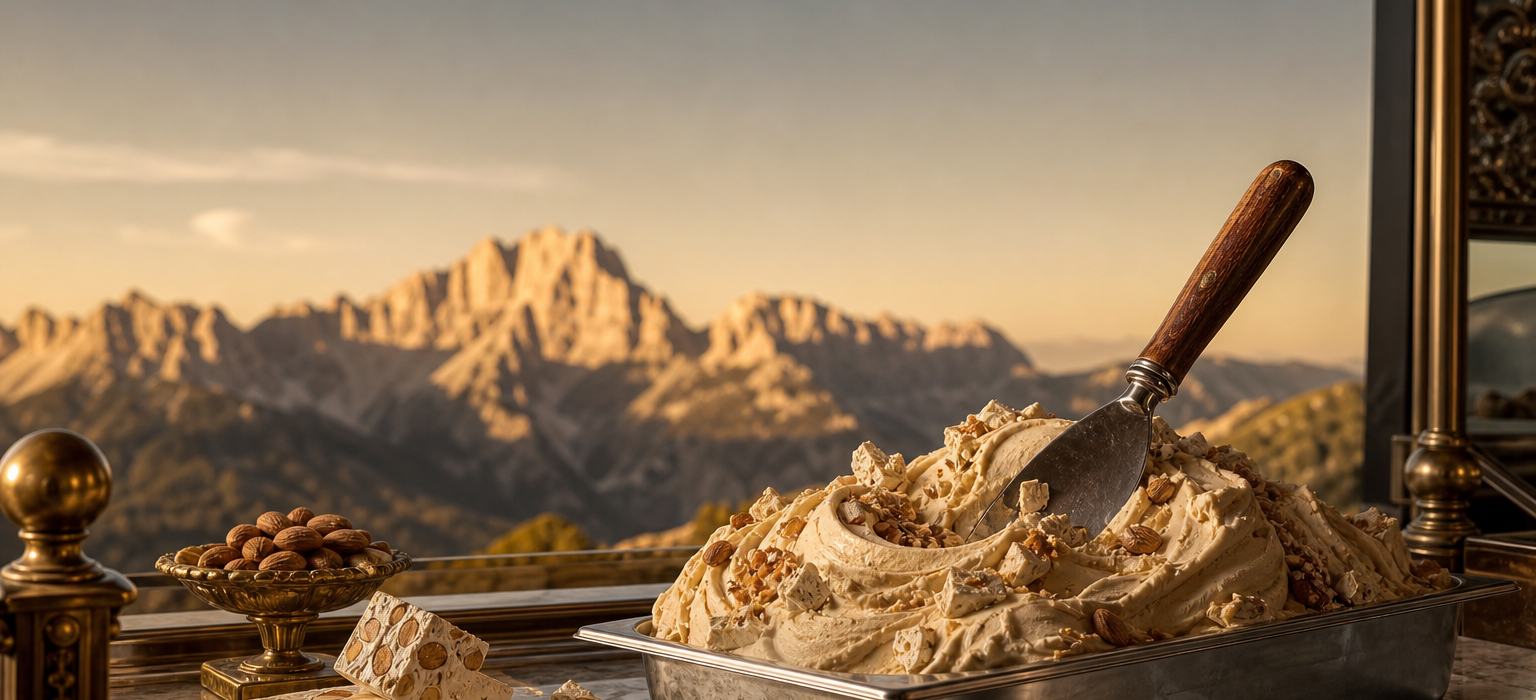
Since the late nineteenth century, L'Aquila has kept alive a tradition of soft chocolate torrone: at the gelateria it becomes a nougat cream with almonds — the signature flavour chosen by this guide.
Few territories go in a single hour from the 2,912 metres of the Corno Grande to the fishing platforms of the Costa dei Trabocchi: Abruzzo gelato lives off this double soul, mountain and maritime.
The quintessential Abruzzo waffle — cooked in a red-hot iron, in a diamond pattern — is the natural companion to a scoop of crema: many gelaterie along the coast offer it in place of the cone.
Before you go: when to visit and what to expect
Three practical pointers are worth more than any preamble.
- On the coast — Pescara, Vasto, Giulianova — full operation runs from May to September: out of season, many seafront shops close or cut back their hours, while those in the historic centers hold up better.
- In the mountains and the inland capitals — L'Aquila, Chieti — the seasonality is gentler: local and university customers keep things going even in winter, and on snowy weekends the plateau villages do as much business as they do in summer.
- On public holidays the crowds double everywhere: on the Pescara seafront at Ferragosto and in L'Aquila on winter Sundays, expect to queue.
Anyone planning a weekend can combine the two sides of the region without much effort: from Pescara it is little more than an hour up the motorway to L'Aquila, and the change in climate — as much as ten degrees cooler — is part of the experience. Gelato, curiously, is unaffected: it sells just as well at twenty degrees as at thirty.
On public holidays the crowds double everywhere: on the Pescara seafront at Ferragosto and in L'Aquila on winter Sundays, expect to queue
Abruzzo's gelaterie between coast and mountains
Pescara is the center of gravity: the region's most populous city, it has the largest concentration of shops, spread between the center, the northern riviera and the fishermen's quarter across the river. Strolling over the Ponte del Mare with a cone in hand is a small local ritual. L'Aquila, second by number of gelaterie, provides the mountain counterpoint: the historic center, gradually brought back to life after the 2009 earthquake, has seen its gelato workshops reopen too, and the gelato goes hand in hand with the city's confectionery tradition, of which torrone is the flagship.
Chieti, from the top of its hill, serves a steady university and local crowd; Vasto pairs a historic old town overlooking the gulf with a beachfront marina, two scenes with different rhythms just a few hundred meters apart; Giulianova completes the picture with the classic combination of upper town and lido. Overall, Abruzzo's gelaterie are fewer than in the neighboring regions — 95 in this census — but the distribution is balanced, and solid workshops are not lacking either at altitude or by the sea.
Strolling over the Ponte del Mare with a cone in hand is a small local ritual
L'Aquila's torrone becomes a flavor for the cone
Torrone is the sweet thread connecting the Abruzzo mountains to their pastry-making. In L'Aquila the historic specialty is soft chocolate torrone, produced in the city for over a century and tied to names every Aquilano knows; a parallel tradition lives on in Guardiagrele and other towns in the province of Chieti. Bringing it into gelato is a natural step: toasted almonds or hazelnuts, honey, the chocolate component of the L'Aquila version — ingredients that churning enhances rather than flattens.
The interpretations split between those who blend the torrone into the base, producing a smooth, honey-scented cream, and those who break it into shards inside a fiordilatte, leaving it to the bite to find the pieces. The second school is the more widespread in the artisanal gelaterie of inland Abruzzo, and delivers the best contrast between the cold of the cream and the chew of the torrone. Visitors to L'Aquila in December will find the flavor at its peak, when the torrone makers' Christmas production also supplies the gelato counters.
Visitors to L'Aquila in December will find the flavor at its peak, when the torrone makers' Christmas production also supplies the gelato counters
How the selection of artisanal gelaterie in Abruzzo was built
The 95 addresses on this page come from public sources — business registers, chamber of commerce listings, the official websites and channels of the individual gelaterie — which the editorial team cross-checks and re-verifies at regular intervals. Businesses that have closed are removed from the list; opening hours and contact details are corrected when they change. No shop can pay to be included or to move up the list: the guide does not sell visibility and does not publish sponsored rankings, in Abruzzo as in every other region.
The criterion for the artisanal label is the same applied across Italy: an in-house workshop, declared or visible, seasonal rotation of flavors, transparency about the origin of ingredients. On the coast the criterion needs extra care, because the short season pushes some businesses toward time-saving semi-finished products; the workshops that instead work with fresh fruit from the hinterland — peaches and grapes from the Val Vibrata, almonds and honey from the inland areas — can be recognized by a menu that changes between June and September. Reader submissions are verified and folded in with every update.
Businesses that have closed are removed from the list; opening hours and contact details are corrected when they change
Beyond the borders: Marche, Lazio and Molise
Abruzzo is a crossroads, and anyone crossing it for gelato has three natural exits. Heading north up the Adriatic, past Giulianova and Martinsicuro, you enter the Marche, where the riviera continues up to Pesaro and the signature flavor shifts from torrone to fig. To the west, beyond the Apennine passes, Lazio brings the metropolitan scale of Rome, a world apart in density and variety of workshops. To the south, Molise continues Abruzzo's coast and mountains in a smaller format, with a scene that is small but not to be dismissed.
The most instructive comparison remains the one along the coast: the same Adriatic beach, from San Benedetto to Termoli, changes accent every fifty kilometers. Anyone leaving Pescara with this guide in their pocket can check for themselves in a weekend, one motorway exit at a time.
To the west, beyond the Apennine passes, Lazio brings the metropolitan scale of Rome, a world apart in density and variety of workshops
The listings
The gelaterie of Abruzzo, town by town
Pescara(20)
Show 12 more in Pescara
L'Aquila(6)
Lanciano(3)
Francavilla al Mare(2)
Montesilvano(2)
San Giovanni Teatino(2)
Alba Adriatica(1)
Capelle Sul Tavo(1)
Caramanico Terme(1)
Fossacesia(1)
Giulianova(1)
Montereale(1)
Roseto degli Abruzzi(1)
San Vito Chietino(1)
Scafa(1)
Spoltore(1)
Sulmona(1)
Vasto Marina(1)
Other towns(37)
Show 29 more in Other towns
FAQ
Gelato in Abruzzo: quick answers
Coast or mountains: which is better for gelato in Abruzzo?
It depends on the season. From May to September the coast — Pescara, Vasto, Giulianova — offers the largest number of open shops and seafront promenades made for a cone on a stroll. For the rest of the year, the best continuity is in inland centers such as L'Aquila and Chieti, where local customers keep the workshops going even in winter.
How many artisanal gelaterie are there in Abruzzo?
This guide catalogs 95 gelaterie across the region, a smaller number than in the neighboring Adriatic regions but evenly distributed between the coast and the inland areas. The cities with the most shops are Pescara, L'Aquila, Chieti, Vasto and Giulianova.
What is L'Aquila torrone gelato?
It is the signature flavor chosen for the region: a tribute to the soft chocolate torrone produced in L'Aquila for over a century. In gelato it appears in two versions — blended into the base, for a cream scented with honey and almond, or in shards inside a fiordilatte, the variant most common in the inland workshops.
Are the gelaterie in Vasto and Giulianova seasonal?
For the most part, yes: the shops at the marinas work mainly from May to September, following the beach-season rhythm. The historic centers — Vasto's upper town and the old town of Giulianova — keep more regular hours, and are the right option for anyone visiting the Abruzzo coast out of season.
How are the gelaterie in this Abruzzo guide chosen?
The addresses come from public sources — business registers, chamber of commerce listings, the businesses' official channels — cross-checked and updated periodically by the editorial team. No gelateria pays to appear and there are no sponsored placements; the artisanal label is assessed on verifiable elements such as an in-house workshop and seasonal flavors.