Artisanal gelaterie
The Best Gelaterie in Friuli-Venezia Giulia: The Complete Guide to the Region's 188 Artisanal Shops
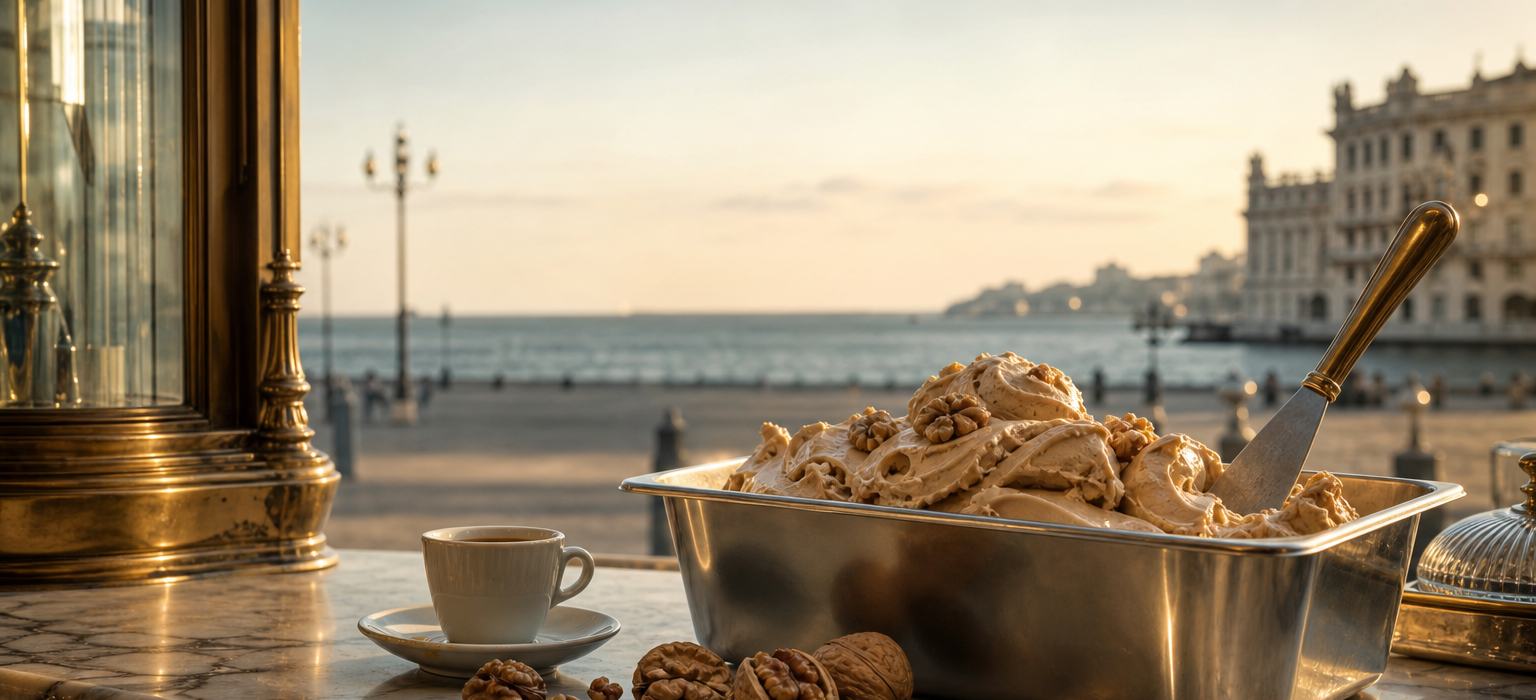
Symbol flavor: walnut — 188 gelaterie, town by town, with maps and verified listings.
The guide
Few Italian regions can tell gelato as a family story. From the valleys of Carnia, between the nineteenth and twentieth centuries, generations of gelato makers set out to open shop in Vienna, in Germany, in the Netherlands: a documented seasonal emigration that made the Friulian trade one of the engines of European gelato. Today that heritage comes home in the 188 gelaterie catalogued by this guide, from Trieste to Udine, from Pordenone to the beaches of Lignano Sabbiadoro and Grado. The editorial team collected them city by city and chose noce (walnut) as the signature flavor: a tribute to the sober tastes of the valleys where it all began.
Like the neighbouring Belluno valleys, Carnia exported gelato makers throughout Mitteleuropa: a well-documented emigration of craftsmen that made "Italian" gelato an institution from Vienna to Berlin.
A free port since 1719 and the historic gateway for coffee into Europe, Trieste has a coffee culture unique in Italy: at the counter it translates into coffee flavours made with serious blends, not syrups.
The dessert of the Natisone valleys — walnuts, raisins, grappa — is a map of flavours that Friulian gelato makers happily raid: walnut remains the flavour that best tells the region's story.
From Carnia to Europe: the story of Friuli's gelato makers
The emigration of gelato makers from the Alpine valleys is one of the most singular chapters in the history of Italian labor. Alongside the celebrated Venetian gelato makers of the Zoldo valley, Carnia and the Friulian valleys also saw entire families leave between the late nineteenth and early twentieth centuries, running gelaterie in the cities of Central Europe in summer and returning to their home villages in winter. Vienna was the first great marketplace, then came Germany and the Netherlands, where many historic gelaterie still carry surnames from these mountains.
That model — family workshop, recipes handed down, seasonal work — left deep traces at home as well. In today's gelaterie of Friuli-Venezia Giulia the same approach is often recognizable: short flavor lists, classic custard flavors executed with precision, wariness toward passing fads. It is not nostalgia; it is craft settled over generations: when a technique is repeated for four of them, it shows in the result, and the counter of a good Carnic gelateria proves it better than any story could.
That model — family workshop, recipes handed down, seasonal work — left deep traces at home as well
Trieste: coffee, Mitteleuropa and cones on the pier
Trieste deserves its own discussion. The city is Italy's coffee capital — a historic import port, home to roasters known around the world and to a coffee culture with a vocabulary all its own — and this identity walks straight into the gelateria display cases. The coffee flavor, a routine presence elsewhere, is a serious matter here: many shops declare which roaster supplies them, and comparing the versions is one of the favorite pastimes of local enthusiasts.
The geography helps: the stroll between the waterfront and Piazza Unità naturally puts a cone in your hand, in summer as on the milder days of the bora wind. Around coffee revolve the other Central European flavors the city carries from its Habsburg history: custards with strudel, poppy seeds, ricotta and honey. Anyone coming to Trieste for the gelato should plan at least two stops: one in the center, one in the neighborhoods off the tourist circuit, home to some of the region's most reliable shops.
The gelaterie of Friuli-Venezia Giulia, city by city
Trieste leads the regional count by number of shops, followed by Udine, which makes up for its smaller size with a remarkable density of workshops in the historic center and nearby villages. The third pole is the coast: Lignano Sabbiadoro concentrates a surprising number of gelaterie for a town that essentially lives from May to September, and Grado — the old beach resort of the Austro-Hungarian aristocracy — follows with similar proportions. Pordenone closes the group of the five main cities, with a scene that is less touristy and more tied to a local clientele.
The distribution reflects the region's two souls: on one side the inland cities, where the artisanal gelaterie of Friuli-Venezia Giulia work year-round for residents; on the other the coastline, where the beach season compresses twelve months of work into five. Off-season travelers will find busy counters in Udine and Pordenone even in November, while in Lignano it is worth checking opening times before setting out.
Pordenone closes the group of the five main cities, with a scene that is less touristy and more tied to a local clientele
Why walnut is the region's signature flavor
Choosing noce — walnut — as the flag flavor of Friuli-Venezia Giulia follows the logic of the whole guide: look for the taste that best tells the territory's story, not the most photographed one. The walnut is the fruit of Friulian farmyards, present in the region's traditional sweets — from gubana, the local spiral pastry, to holiday fillings — and gelato brings out its best: rich in just the right measure, faintly bitter on the finish, able to carry a generous churn without turning cloying.
The best versions start from whole walnuts toasted in-house, not from ready-made pastes, and can be recognized by the color — a muted beige, never too pale or caramelized — and by the irregular crumble. Some gelato makers pair it with honey, others with a vein of coffee that in Trieste is practically mandatory. It is worth using as the test flavor in the gelaterie of Friuli-Venezia Giulia: a well-made walnut gelato is almost always the signature of a workshop that takes the rest of its display case just as seriously.
Some gelato makers pair it with honey, others with a vein of coffee that in Trieste is practically mandatory
The method behind the guide to Friuli-Venezia Giulia's artisanal gelaterie
The 188 addresses catalogued on this page come from public sources: business registers, chamber of commerce listings, and the official sites and profiles of the individual shops. The editorial team cross-references this data, verifies it and updates it at regular intervals, removing shops that have closed and correcting practical details when they change. No gelateria pays to appear, no position is sponsored and there are no paid rankings: the list photographs the territory, it does not rank it by merit.
For the artisanal label, the editorial team looks at verifiable elements: an in-house workshop that is declared or visible, flavors that rotate with the seasons, transparency about the origin of ingredients. It is a cautious criterion, one that prefers to exclude a doubt rather than include a marketing promise. Anyone who runs a gelateria and spots outdated information — an opening time, an address, a closure — can report it: the correction goes into the guide's next scheduled update.
It is a cautious criterion, one that prefers to exclude a doubt rather than include a marketing promise
Continuing west: Veneto and Trentino-Alto Adige
The Northeast's gelato journey does not end at the Tagliamento river. To the west lies Veneto, the other great motherland of emigrant gelato makers: the Zoldo and Cadore valleys exported the trade as much as Carnia did, and the comparison between the two traditions — so similar in origin, so different in their urban outcomes between Venice and Verona — is one of this guide's running threads. Higher up, Trentino-Alto Adige plays a different game, built on alpine-pasture milk and valley fruit, with the Val di Non apple as its banner.
For anyone driving the A4 motorway or riding the Venice-Trieste railway, the practical advice is simple: three regions, three signature flavors — walnut, and then whatever Veneto and Trentino bring to the table — and a few hundred kilometers best measured one stop at a time.
Higher up, Trentino-Alto Adige plays a different game, built on alpine-pasture milk and valley fruit, with the Val di Non apple as its banner
The listings
The gelaterie of Friuli-Venezia Giulia, town by town
Lignano Sabbiadoro(18)
Trieste(17)
Show 9 more in Trieste
Udine(10)
Show 2 more in Udine
Grado(8)
Gorizia(5)
Sacile(4)
Cividale del Friuli(3)
Codroipo(3)
Pordenone(3)
Palazzolo dello Stella(2)
Ronchi dei Legionari(2)
San Canzian d'Isonzo(2)
Aquileia(1)
Aviano(1)
Azzano Decimo(1)
Bagnaria Arsa(1)
Casarsa della Delizia(1)
Cervignano del Friuli(1)
Duino Aurisina / Devin - Nabrežina(1)
Feletto Umberto(1)
Gradisca d'Isonzo(1)
Majano(1)
Mariano del Friuli(1)
Mortegliano(1)
Pagnacco(1)
Pasian di Prato(1)
Pavia di Udine;Percoto(1)
Polcenigo(1)
Premariacco(1)
Resiutta(1)
Roveredo in Piano(1)
San Giovanni al Natisone(1)
Staranzano(1)
Tavagnacco(1)
Tricesimo(1)
Turriaco(1)
Valvasone Arzene(1)
Other towns(74)
Show 66 more in Other towns
FAQ
Gelato in Friuli-Venezia Giulia: quick answers
Why does Friuli-Venezia Giulia have such a strong gelato tradition?
Because of the seasonal emigration of gelato makers from the Alpine valleys, Carnia above all, in the nineteenth and twentieth centuries. Entire families ran gelaterie in Vienna, Germany and the Netherlands, returning to their valleys in winter. That trade, handed down for generations, is still reflected in the average quality of the region's workshops today.
How many gelaterie does the guide count in Friuli-Venezia Giulia?
The guide catalogues 188 gelaterie across the region — the highest number in the Northeast relative to population among the regions covered so far. The cities with the most shops are Trieste, Udine, Lignano Sabbiadoro, Grado and Pordenone, with the coastline living through an intensely seasonal summer trade.
What is the walnut flavor and where is it worth trying?
It is the signature flavor chosen for the region: a custard base built on toasted walnuts, rich and slightly bitter on the finish. The best versions start from whole nuts processed in-house and can be recognized by their muted beige color. It is found throughout the region, with notable interpretations reported between Udine and Carnia.
Is Trieste a good gelato city?
Yes, and it is a special case: Trieste's coffee culture — a historic import port and home to celebrated roasters — feeds directly into the display cases, where the coffee flavor is taken very seriously. Around it revolve Central European tastes such as poppy seed, strudel and ricotta with honey, a legacy of the city's Habsburg history.
Do the gelaterie of Lignano Sabbiadoro and Grado close in winter?
For the most part, yes: both towns live off the beach season, and many shops operate from May to September, with partial openings on spring weekends. Anyone looking for gelato between October and April will find more continuity in the inland cities, above all Udine and Pordenone, where local customers sustain the workshops year-round.