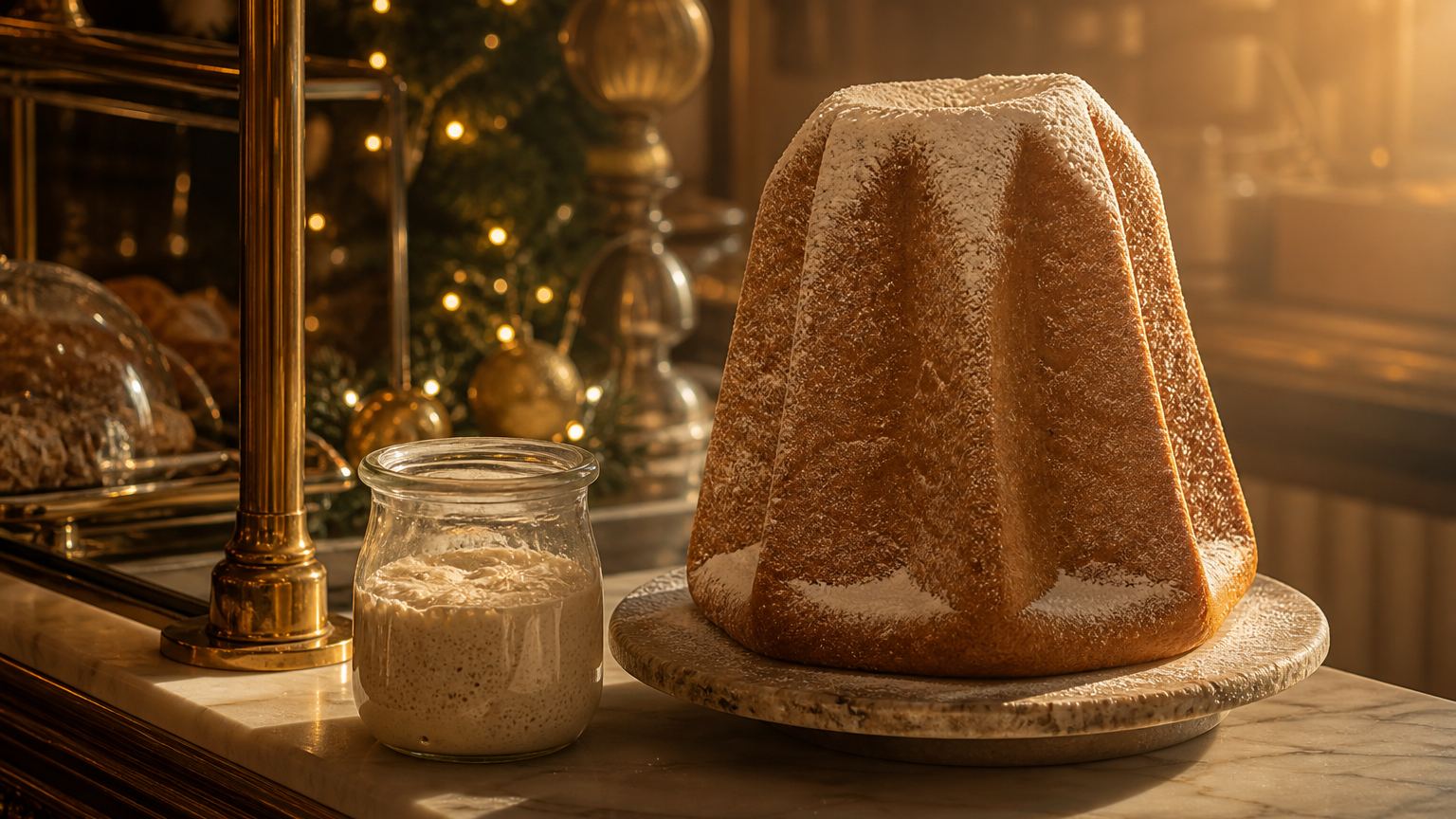
Festive breads
Laminated Pandoro with Sourdough Starter: How the Recipe Is Born, What Makes It Special and How to Recognize It
Laminated pandoro made with sourdough starter is the acid test of festive baking: a dough that has to be at once as rich as a brioche, as light as a cloud and as layered as puff pastry. When it's done well, you can tell at the first pull: the crumb opens into vertical veils, smells of butter and vanilla, and needs no dusting of icing sugar to win you over.
This guide explains what sets a laminated pandoro apart from a classic one, what role the sourdough starter plays, why artisanal production times are measured in days, and how to recognize a well-made piece at the pastry counter — or next to the tub of gelato it traditionally partners with at Christmas.
What "laminated" means: the difference from classic pandoro
Traditional pandoro is a whipped dough rich in butter, eggs and sugar, baked in the star-shaped mold: its texture is soft and uniform. Laminated pandoro adds a step borrowed from viennoiserie: the dough is laminated — rolled out and folded repeatedly around a slab of butter, as is done for croissants and puff pastry.
Those folds create alternating layers of dough and butter that separate ever so slightly in the oven: the result is a crumb that doesn't cut but flakes, with veils that peel off vertically along the grain of the bread. On the palate the difference is unmistakable: more perceived lightness, more surface meeting the tongue, more buttery aroma released with every layer.
It is also a balancing act: too much lamination and the pandoro becomes just another brioche; too little and "laminated" remains a promise on the label.
The role of the sourdough starter in pandoro
The sourdough starter — a dough of flour and water populated by wild yeasts and lactic bacteria, refreshed for years — is the slow engine of all the great Italian festive breads. In pandoro it does three jobs in one.
First, the rise: slower and more gradual than brewer's yeast, spread across several successive doughs over 36-72 hours. Second, the aroma: lactic fermentation produces that bouquet — panna cotta, honey, candied citrus even where no candied fruit is present — that brewer's yeast cannot deliver. Third, keeping quality: the starter's natural acidity keeps the pandoro soft for weeks without preservatives.
It is also why laminated pandoro with sourdough starter costs what it costs: behind every star-shaped mold lie days of refreshments, overnight doughs and a patience that cannot be industrialized.
How the pastry chef works: the stages of artisanal production
Producing an artisanal laminated pandoro follows a precise score. It starts with the refreshments of the sourdough starter, repeated several times through the day to bring it to peak strength. Then comes the first dough, in the evening: strong flour, sugar, egg yolks, butter and the starter, left to rise all night until tripled.
The next morning comes the second dough, with more eggs, sugar, butter, honey and vanilla. Then the step that gives the cake its name: the lamination, with the dough rolled and folded around the butter in several turns. After shaping into a ball and rounding, the dough rests in the star mold for the final rise, another 6-10 hours.
Baking is gentle and long; cooling, often upside down like its cousin panettone, keeps the structure from collapsing. From first refreshment to wrapping usually takes two or three days.
How to recognize a good laminated pandoro at the counter
Without opening the wrapper, three clues matter. The label: the ingredient list of an artisanal pandoro is short — flour, butter, egg yolks, sugar, sourdough starter, honey, vanilla, salt — with butter near the top and no vegetable fats. The weight in the hand: a good festive bread is lighter than its volume suggests. The origin: the workshop producing it should have a name and address, not just a fantasy brand.
The tasting brings confirmation: a slice that flakes into veils, air pockets stretched upward, an aroma of fresh butter rather than artificial flavoring, a sweetness that doesn't smother. A marked sour aftertaste betrays a badly managed starter; a gummy crumb, a rushed rise.
And the best pairing remains the one from holiday tradition: a slice just barely warm and a scoop of custard or fior di latte gelato — for how to choose it, the guide to artisanal gelaterie region by region is the right place to start.
Butter: this is where the lamination is decided
In a laminated pandoro, butter is not one ingredient among others — it is the tool. Its job is to build the layers, and to do that it has to stay plastic: cold enough not to be absorbed into the dough, soft enough to roll out without cracking. Workshops that laminate seriously almost always use centrifugal butter, churned from fresh cream rather than from whey, with a higher melting point and a far cleaner milk aroma. It costs more, and you notice that both on the price tag and at the first pull.
Temperature is the rest of the craft. The working window sits around 14-16 °C: above it the butter migrates into the gluten network and the layers are lost; below it, it shatters and tears the dough. That is why lamination happens in several passes, with rests in the fridge between folds, and why a laminated pandoro cannot be improvised on a hot day. If you tried it at home in July and got an ordinary pandoro, the recipe was not the culprit.
How to store it and how to slice it
An artisanal laminated pandoro belongs in its own bag, closed, at room temperature and away from any heat source. The fridge is the most common mistake: below 6-7 °C the starch retrogrades and the crumb turns dry within a day. If the house is cold, half an hour near a radiator before serving brings the aroma and softness back; some pastry chefs suggest three minutes in an oven at 50 °C, switched off and barely warm.
On slicing there are two schools. Vertical wedges is the family method, quick and unfussy. Horizontal discs — lay the pandoro on its side and slice it like a salami — is the one that does the lamination justice, because every slice shows the cross-section of the veils instead of cutting through them. It is also the shape that carries a scoop of gelato in the middle without crumbling, which on a December counter is the most requested pairing after mascarpone.
The recipe at home: what it really takes
Homemade laminated pandoro is a project for bakers who already have some mileage: it takes an active, strong sourdough starter, a stand mixer, a thermometer, strong flour (W 350 or higher), quality lamination butter and two free days on the calendar. The classic proportions of the rich dough — on the order of 500 grams of flour, 300 of total butter, 200 of sugar and a generous share of egg yolks — vary from recipe to recipe, but the logic of the two doughs and the lamination remains as described above.
The honest advice: anyone who has never handled a large festive bread should start with the classic non-laminated pandoro, which is more forgiving, and get to lamination by the second Christmas. And those who prefer to buy it are spoiled for choice: December is the season when artisanal pastry shops and gelaterie — many of which become festive-bread workshops in winter — do their best work.
FAQ
Laminated pandoro and sourdough starter: the most common questions
What is the difference between classic pandoro and laminated pandoro?
The classic is a whipped dough with a soft, uniform crumb; the laminated version is also folded with butter, like puff pastry, and the crumb opens into vertical veils. Texture, perceived lightness and the intensity of the buttery aroma all change.
Why is sourdough starter better than brewer's yeast in pandoro?
It gives a slower, more stable rise, a richer aromatic profile and longer natural keeping quality. In exchange it demands days of work: it is the main reason for the price difference with industrial products.
How long does an artisanal pandoro with sourdough starter keep?
Generally three to four weeks from wrapping, thanks to the natural acidity of the sourdough starter, with no added preservatives. It should be kept away from heat sources and sealed well after opening.
How should laminated pandoro be served?
Slightly warm is best: a few minutes near a warm oven are enough to reawaken the butter in the layers. The classic holiday pairing is a scoop of custard or fior di latte gelato, or a mascarpone cream.
Can a laminated pandoro be kept in the fridge?
Better not: below 6-7 °C the starch retrogrades and the crumb dries out within a day. Keep it closed in its bag at room temperature, away from heat sources. If the house is cold, half an hour somewhere warm before serving is enough to recover the aroma and softness.
Why does centrifugal butter make a difference?
Because it has a higher melting point and a cleaner milk aroma than whey butter: it stays plastic inside the 14-16 °C working window, so it builds layers instead of being absorbed into the dough. That is the technical reason an artisanal laminated pandoro costs more than an industrial one.
Can laminated pandoro be made without sourdough starter?
Technically yes, with brewer's yeast and shorter times, but you lose aroma and keeping quality: the result is closer to a star-shaped laminated brioche than to a pandoro for special occasions.