Artisanal gelaterie
Gelaterie in Molise: The Guide to the Best Artisanal Gelaterie in Campobasso, Termoli and Isernia
Symbol flavor: honey — 9 gelaterie, town by town, with maps and verified listings.
The guide
Nine artisanal gelaterie on record: together with the Valle d'Aosta, Molise is one of the smallest territories in this guide. Reading that as a limitation would be a mistake. In a region where the distance between producer and workshop is measured in minutes, gelato keeps a relationship with the countryside that has been lost elsewhere: the honey comes from local beekeepers, the milk comes down from Apennine pastures, the fruit follows the seasons without forcing. Honey, the signature flavor chosen for this page, sums all of this up. The guide covers Campobasso, Isernia and the coast at Termoli, the three cardinal points of gelato in Molise.
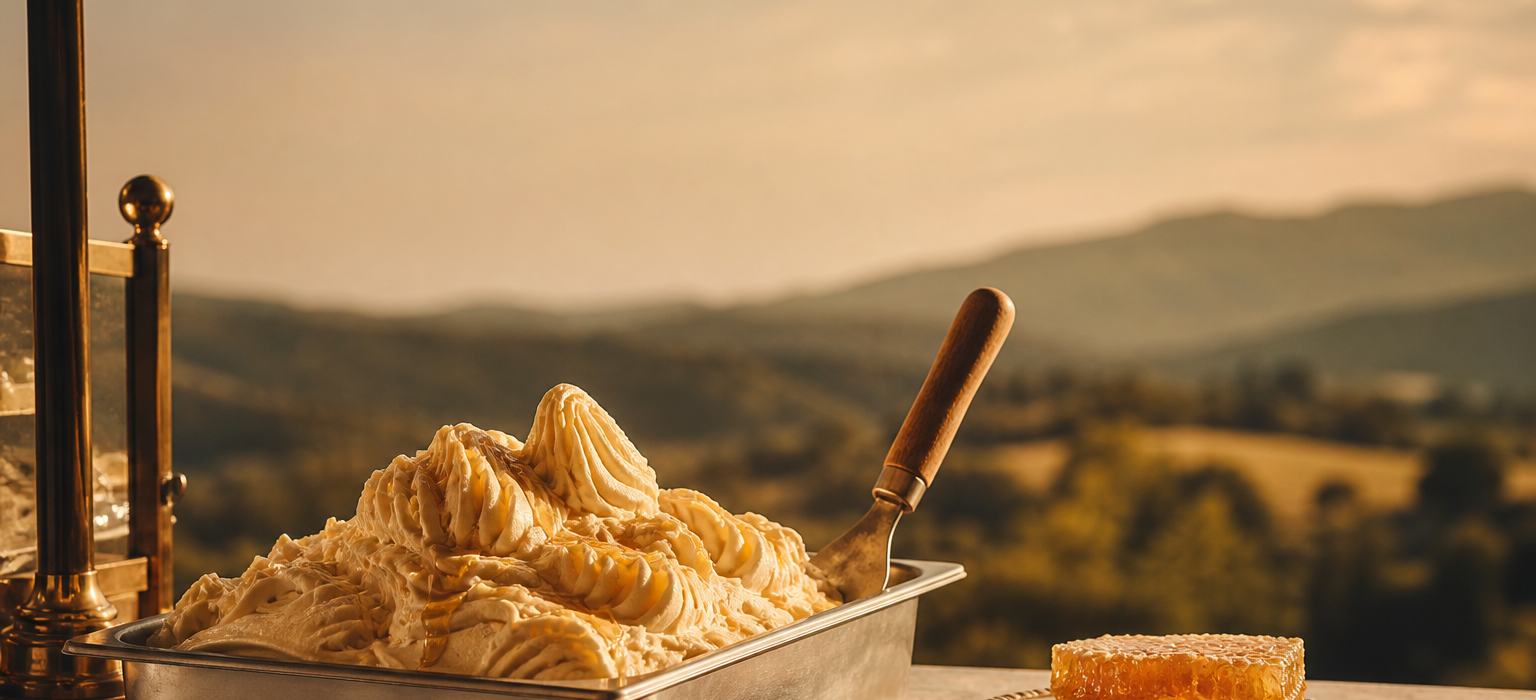
Among the pastures and woods of the Molise Apennines, beekeeping is an ancient trade: honey gelato — wildflower or sulla — is the most direct way to taste the region.
Podolica cows, raised free-range along the old drovers' roads, give a rare, rich milk: wherever a gelato maker manages to source it, the crema has a depth that is hard to forget.
Thirty-five kilometres of coast, an old town perched on a rocky spur and the trabucchi fishing platforms: the Molise gelato season is concentrated here, short and crowded as a village festival.
A small territory you can taste by the spoonful
Molise is a land of villages, old drovers' trails and mountains sliding down toward a short stretch of Adriatic coastline. This geography shapes the gelato more than it might seem: there are no big cities and no big crowds, so there are also none of the chains and cookie-cutter formats that fill historic centers elsewhere. What remains is a handful of genuine workshops, each tied to its own village or town, working for a clientele of residents and for a still-measured flow of tourists.
For anyone looking for artisanal gelato, Molise offers an experience the denser regions cannot replicate: the supply chain is visible to the naked eye. The beekeeper who supplies the honey often works a few kilometers from the counter; the dairy that provides the milk is the one in the next village over. Gelaterie in Molise have no need to present zero-mile sourcing as a marketing strategy, because for them it is simply the normal way to stock the workshop. It is the quiet advantage of small territories, and it is worth the detour off the Adriatic motorway.
It is the quiet advantage of small territories, and it is worth the detour off the Adriatic motorway
Honey, the common thread of gelato in Molise
Beekeeping has deep roots in Molise: the Apennine blooms, fields farmed without the pressures of intensive agriculture and a wide range of altitudes produce honeys that differ markedly from one another, from mountain wildflower honey to seasonal single-flower varieties. In gelato, honey is a harder ingredient than it appears: it replaces part of the sugars, changes the structure of the mix and forces the gelato maker to rebalance the recipe for every type of honey used.
That is exactly why a good honey gelato is a reliable indicator of a workshop's level. The most typical version pairs it with a milk base, where the honey's aromatic sweetness comes through with nothing masking it; some interpretations add walnuts or ricotta, in keeping with the farmhouse baking of the Apennines. Anyone passing through Campobasso or Isernia would do well to look for it in the display and, if it is there, to ask which beekeeper it comes from: in most cases the answer is a name and a village, not an anonymous supplier. That is the kind of detail that sets Molise apart.
That is exactly why a good honey gelato is a reliable indicator of a workshop's level
Apennine milk, the other half of the recipe
If honey is the signature, milk is the structure. The pastures of the Molise Apennines, between the Matese massif and the mountains of the upper Volturno, feed a dairy tradition known above all for its stretched-curd cheeses, but the same quality milk that becomes caciocavallo and stracciata is the ideal base for a cream-style gelato. Summer grazing at altitude enriches the milk with aromatic notes that an attentive workshop knows how to preserve in the mix, rather than flattening them with added flavorings.
The artisanal gelaterie in Molise that work with milk of declared origin tend to keep their displays short: a few dozen flavors at most, often fewer, with the cream flavors front and center and the fruit tied to the calendar. It is the opposite model to the endless display case, and it is generally a good sign: a shop that produces small batches, often, with local raw materials has no need to fill the counter. A fior di latte made with Matese milk, tasted with nothing added, works as an entrance exam for any address in the region.
A fior di latte made with Matese milk, tasted with nothing added, works as an entrance exam for any address in the region
Gelaterie in Molise city by city: Campobasso, Isernia and the Termoli coast
The nine addresses in Molise are split between the two provincial capitals and the coast. Campobasso, the regional capital, offers the most consistent setting: here gelato is eaten all year round, with the evening stroll through the center, between the corso and the public gardens, keeping the workshops alive even in the cold months. Isernia, smaller and further inland, embodies the dimension of an Apennine provincial town, where the gelateria is a social institution before it is a business.
Termoli is another story. The old town on its promontory, the port and the beaches make it the summer capital of Molise, and the gelato season follows the beach season: from June to August the workshops on the coast run at full tilt, with evening queues along the promenade, while in winter the center of gravity shifts back inland. Anyone looking for gelaterie in Molise in the warm months should start right here, perhaps ending a day at the sea with a cone in front of the old town walls, where the Adriatic breeze does half the work.
How the editorial team keeps the guide to Molise's artisanal gelaterie current
With nine addresses, the Molise page is among the simplest to keep accurate, and it is also the one where every change carries the most weight: a single closure amounts to more than a tenth of the sample. The information comes from public sources, business registers, the shops' official channels and documented reader reports; the editorial team checks every listing and corrects it when management, premises or seasonal opening patterns change — a particularly relevant detail for the Termoli coast.
As with every region in the guide, no gelateria in Molise can pay to be included or to gain more visibility: the list contains no sponsored placements. Readers who notice outdated information can report it, and in such a compact territory checks are quick. The small number has one final advantage for travelers: Molise is the only region, together with the Valle d'Aosta, where visiting every single gelateria on record is a realistic project for one long weekend.
Readers who notice outdated information can report it, and in such a compact territory checks are quick
Open borders: Abruzzo, Puglia and Campania
Molise borders territories where gelato changes register within a few kilometers. To the north, the gelaterie of Abruzzo continue the Apennine story with larger numbers and a longer coastline. To the south-east, Puglia opens the chapter of the great Adriatic gelato and its seafront cities. To the west, Campania fields one of the country's most important schools of gelato and cold pastry.
For anyone driving the Adriatic route, the natural sequence is Abruzzo, Molise, Puglia: three regions within a few hours of road, three different ways of understanding a cone. The editors' advice is not to treat Molise as a mere corridor between larger neighbors: the stop in Termoli, the climb up to Campobasso or the detour to Isernia pay off with a gelato that knows exactly where it comes from, made with a honey that has a name and milk that has a pasture. It is the kind of concreteness no metropolitan display case can offer at the same price.
To the north, the gelaterie of Abruzzo continue the Apennine story with larger numbers and a longer coastline
The listings
The gelaterie of Molise, town by town
Campomarino(1)
Fossalto(1)
Mirabello Sannitico(1)
Rocchetta a Volturno(1)
Termoli(1)
FAQ
Gelato in Molise: quick answers
How many artisanal gelaterie are there in Molise?
The guide records 9 artisanal gelaterie in Molise, spread across Campobasso, Isernia and the Termoli coast. It is one of the lowest counts in Italy, consistent with the region's population and geography. The editorial team updates the list with every documented opening, closure or change of management.
Why is honey the signature flavor of Molise?
Because beekeeping is one of the region's most characteristic activities, favored by the Apennine blooms and by farming that is rarely intensive. In gelato, honey is technically demanding, so a good honey flavor signals a capable workshop. Many gelato makers in Molise buy from local beekeepers whose name and village they can point to.
What is the best time of year for gelato in Termoli?
The beach season, from June to August, when the old town and the seafront are at the height of their evening life and the workshops run at full capacity. Out of season, some businesses on the coast cut their hours or close, while in Campobasso and Isernia gelato remains available all year round.
Is the milk used by gelaterie in Molise local?
In many of them, yes: the Apennines, and the Matese area in particular, have a living dairy tradition, and the more careful workshops declare where their milk comes from. It is not an automatic rule, though, so it is always worth asking at the counter. A fior di latte tasted on its own is the quickest way to form an opinion.
Can you visit all of Molise's gelato in one weekend?
Yes, and it is one of the region's peculiarities: with nine addresses between Campobasso, Isernia and Termoli, a long weekend is enough to complete the circuit. Internal distances are short and the route crosses both the Apennines and the Adriatic coast, with the bonus of tasting mountain honey and milk just a few hours from the sea.