Artisanal gelaterie
Artisanal gelaterie in Calabria: the complete guide to tartufo di Pizzo, bergamotto and 75 addresses
Symbol flavor: bergamot — 75 gelaterie, town by town, with maps and verified listings.
The guide
Few regions can claim a place in the history of Italian gelato with credentials like Calabria's. This is where the tartufo di Pizzo was born, the first gelato in Europe to earn Protected Geographical Indication status; and this is where — practically nowhere else — the bergamot of Reggio Calabria grows, a citrus fruit with an unmistakable fragrance that this guide has chosen as the region's signature flavor. Around these two traditions works a scene of 76 artisanal gelaterie, spread across Reggio Calabria, Tropea, Cosenza, Catanzaro and Pizzo itself. The page that follows starts from tradition, as Calabria demands, and ends with today's addresses.
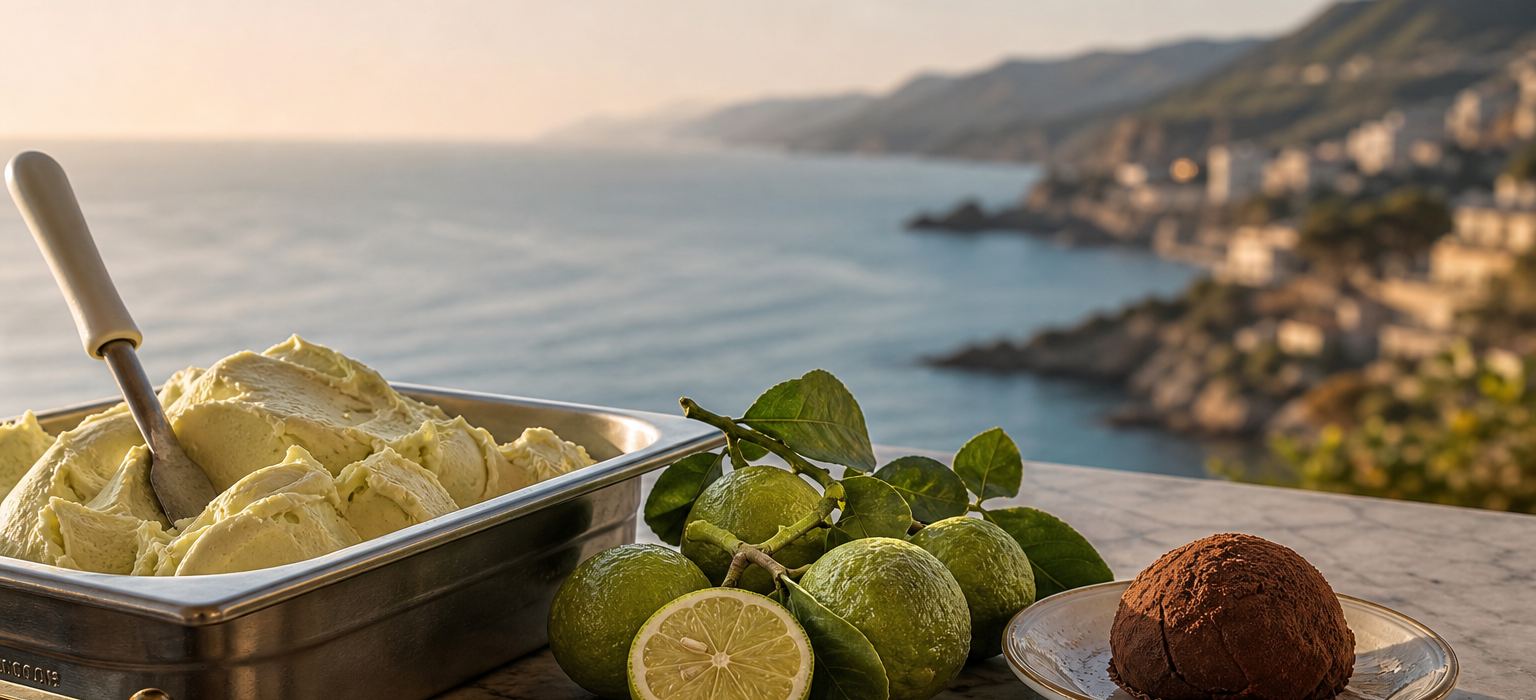
It is the first gelato in Europe to have earned the IGP mark: a sphere of hazelnut and chocolate with a molten cocoa heart, born in the bar-gelaterie overlooking Piazza della Repubblica in Pizzo Calabro.
It grows almost exclusively along the Reggio coast, protected by the DOP: its oil perfumes the world's great teas, and in the carapina it becomes an elegant sorbet, bitter and floral at once.
Between the Tyrrhenian and the Ionian, Calabrian gelato changes face within a few kilometres: citrus and Rossano liquorice on the Ionian side, figs and Tropea red onion — yes, even at the gelateria — on the Tyrrhenian one.
The tartufo di Pizzo, a tradition with IGP recognition
The obligatory starting point is a small town overlooking the Gulf of Sant'Eufemia. The tartufo was born in Pizzo Calabro, in the province of Vibo Valentia: a hemisphere of hazelnut and chocolate gelato with a molten chocolate core, dusted in bitter cocoa powder. The traditional technique calls for shaping it by hand, in the palm, without molds — a gesture the historic gelaterie on Pizzo's main square have handed down for generations, and one that sets the authentic product apart from the industrial imitations found everywhere.
In 2016 the tartufo di Pizzo obtained Protected Geographical Indication status, becoming the first gelato in Europe to carry an IGP mark: a recognition that ties the product to the town's territory and its traditional workmanship. For anyone visiting Calabria, tasting one on the town square, ideally at sunset with the Tyrrhenian Sea in view, remains a founding ritual of Italian gelato. That is why this guide to Calabria begins with tradition rather than numbers: without Pizzo, the story of gelato in Italy's South would be a different one.
Bergamotto of Reggio Calabria, the region's signature flavor
The second pillar of Calabrian tradition grows along a strip of Ionian coastline in the province of Reggio Calabria, and almost nowhere else in the world: the bergamot. The citrus fruit, whose essential oil holds Protected Designation of Origin status, was for decades destined almost exclusively for perfumery; only relatively recently have Reggio's gelaterie brought it into their display cases, turning it into a sorbet that now serves as the calling card of the entire region.
The flavor is unmistakable: citrusy but not reducible to lemon, elegantly bitter, with an aromatic length that recalls the perfume more than the fruit. A good bergamotto sorbet uses the juice and zest of the fresh fruit, available in the winter months, or locally processed bergamot for the rest of the year; versions built on flavorings alone give themselves away with a flat finish. The editorial team chose it as the symbol of Calabria's artisanal gelaterie precisely because it is impossible to relocate: the recipe can be copied anywhere, but the raw material remains Reggio's own.
Tropea onion in a cone, from curiosity to summer ritual
Alongside its two major traditions, Calabria cultivates its most photographed oddity: gelato made with the red onion of Tropea. The onion from the promontory near Vibo, protected by the IGP mark as Cipolla Rossa di Tropea Calabria, is naturally sweet — so much so that it has long been used in jams and sweet-and-sour preparations; its move into gelato, however provocative it may sound, has a gastronomic logic of its own. The most successful versions work the onion, cooked or as a jam, into a cream base, producing a sweet flavor with a savory undertone that surprises without putting anyone off.
In the old town of Tropea, among the alleys overlooking the beach and the rock of Santa Maria dell'Isola, tasting it has become a small summer ritual for visitors, halfway between a dare and a discovery. It would be wrong to dismiss it as a tourist gimmick: it is rather the sign of a region confident enough in its flagship products to play with them. Anyone who remains skeptical can fall back, without regret, on a citrus sorbet, another strong point of the Tyrrhenian display cases.
It would be wrong to dismiss it as a tourist gimmick: it is rather the sign of a region confident enough in its flagship products to play with them
Artisanal gelaterie in Calabria: 75 addresses from Reggio to Cosenza
With 75 addresses on record, Calabria's artisanal gelato scene is by far the largest among the regions in this section of the guide. The distribution follows the cities and the coasts. Reggio Calabria leads the group: its seafront promenade, with the Strait and Sicily in view, is one of the most scenic gelato walks in Italy, and the cultural closeness to Messina also shows in how widespread granita is alongside classic gelato. Cosenza and Catanzaro represent steady urban consumption, tied less to tourism and more to a resident clientele, with Cosenza's historic center and Catanzaro's main street as natural axes.
Tropea and Pizzo, though small, punch above their weight: the former for the intensity of its summer season, the latter for the tartufo pilgrimage that now lasts all year round. Calabrian gelaterie share one common trait: a long season. The climate allows for gelato from March well into October, and along the coasts an evening gelato remains a habit even in September, when display cases elsewhere are already winding down.
Calabrian gelaterie share one common trait: a long season
The editorial work behind Calabria's gelaterie
The 76 Calabrian listings are drawn from public sources: business registers, the shops' official websites and channels, documentation from the consortia protecting labeled products such as the tartufo di Pizzo IGP and bergamot DOP, plus well-substantiated reader tips. The editorial team verifies that every address corresponds to genuine artisanal production and updates the listings with every documented change of ownership, premises or seasonal opening — frequent along the coasts. No gelateria can pay to appear in the guide or to obtain a prominent position: the page hosts no sponsored rankings.
On a scene this large, the editorial team pays particular attention to claims of tradition: the name tartufo di Pizzo, for instance, has a precise meaning tied to the IGP production rules and the town's territory, and the listings distinguish the protected product from the generic chocolate gelato hemispheres sold under similar names. It is the kind of verification a guide owes its readers, all the more so in a region where tradition is the main asset.
No gelateria can pay to appear in the guide or to obtain a prominent position: the page hosts no sponsored rankings
Beyond the Pollino and across the Strait: where to go next
Calabria's position offers two natural continuations and one by sea. Heading up the Tyrrhenian side past the Pollino massif leads into Basilicata, where Maratea continues the coastal story and the strawberries of the Metaponto plain change the register of the fruit flavors. Further north, Campania opens the chapter of the South's great pastry schools. The third border is made of water: from the Strait of Messina, a ferry ride away, lie the gelaterie of Sicily, homeland of granita and brioche col tuppo, with which Reggio has always been in dialogue.
For anyone building a gelato journey through the South, Calabria works as a hinge: enter from Maratea, head down to Pizzo and Tropea, finish on Reggio's seafront and leave by boat. The tartufo and the bergamotto, tasted a few hours apart, remain the best summary of what this region has given the gelato maker's craft.
Further north, Campania opens the chapter of the South's great pastry schools
The listings
The gelaterie of Calabria, town by town
Taurianova(6)
Polistena(3)
Borgata Marina(2)
Reggio di Calabria(2)
Catanzaro(1)
Jacurso(1)
Lago(1)
Rende(1)
San Demetrio Corone(1)
Sant'Andrea Marina(1)
Soverato(1)
Other towns(51)
Show 43 more in Other towns
FAQ
Gelato in Calabria: quick answers
How many artisanal gelaterie are there in Calabria?
The guide lists 76 artisanal gelaterie in Calabria, the highest number among the small and mid-sized southern regions covered in this section. The addresses are concentrated in Reggio Calabria, Cosenza and Catanzaro, with Tropea and Pizzo highly significant relative to their size. The list is kept up to date by the editorial team using public sources.
What exactly is the tartufo di Pizzo?
It is a hemisphere of hazelnut and chocolate gelato with a molten chocolate core, coated in bitter cocoa and shaped by hand without molds, following the tradition of Pizzo Calabro. Since 2016 it has been protected by the IGP mark — the first gelato in Europe to earn one — which ties it to the town's territory and traditional workmanship.
Why is bergamotto Calabria's signature flavor?
Because the bergamot grows almost exclusively along the coast of Reggio, and its essential oil holds Protected Designation of Origin status. No other region can offer the same sorbet made from its own raw material: it is a flavor that is literally impossible to relocate, citrusy and elegant, and it has become the calling card of Reggio's gelaterie.
Is Tropea red onion gelato actually good?
Better than the name suggests. The red onion of Tropea, protected by the IGP mark, is naturally sweet and is worked, cooked or as a jam, into a cream base: the result is a sweet flavor with a savory undertone. It remains a one-scoop curiosity, but well-made versions are a pleasant surprise.
How long does the gelato season last in Calabria?
Longer than almost anywhere else in Italy: the climate allows for regular gelato from March well into October, and along the coasts an evening cone remains a habit even in September. In inland cities such as Cosenza and Catanzaro many workshops operate year-round, while some seaside businesses in Tropea cut back their hours in winter.