Artisanal gelaterie
Artisanal Gelaterie of Basilicata: a Complete Itinerary and Guide from Matera to Maratea
Symbol flavor: strawberry — 21 gelaterie, town by town, with maps and verified listings.
The guide
Basilicata lends itself to being told as a journey rather than a list: 21 artisanal gelaterie spread across a territory that runs from the Sassi of Matera to the mountains of Potenza, down to the Tyrrhenian cliffs of Maratea. The signature flavor chosen for this page is strawberry, and not out of convention: the plain of Policoro and the Metaponto area host one of Italy's most important strawberry-growing districts, with the variety known as candonga now a byword for Lucanian production. The itinerary that follows crosses the region from east to west, stop by stop, with the cone as the pretext and the landscape as the real destination.
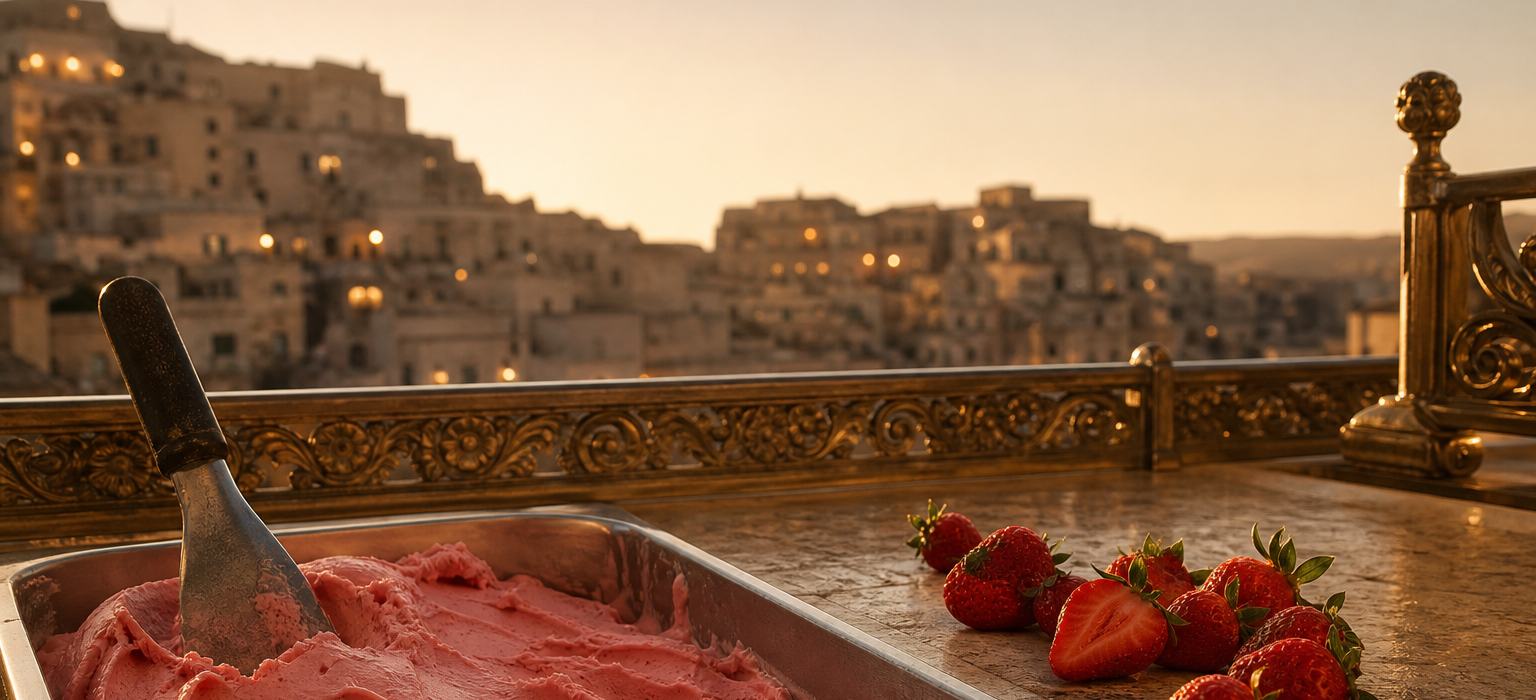
The plain of Policoro, on the Ionian coast, is one of Italy's most important strawberry districts: in the right months, Lucanian strawberry sorbets have an extra gear that is missing elsewhere.
A stroll through the Sassi with a cone in hand has become a rite worthy of a capital of culture: Matera's counters have grown in number and ambition together with the city.
The crusco pepper of Senise, crisp and sweet, has tempted more than one Lucanian gelato maker: where it appears, usually on a chocolate or cream base, it is the curiosity worth a chat with the person behind the counter.
Starting in Matera: gelato among the Sassi
The itinerary begins in the region's most famous city. Matera, with its districts carved into the tuff and a flow of visitors that has grown steadily since its year as European Capital of Culture, is today the main gelato market in Basilicata. Walking between the Sasso Barisano and the Sasso Caveoso works up an appetite: the climbs are constant, the stairways never end, and the cone in hand has become as much a part of the urban landscape as the tuff facades.
To find your bearings, a simple criterion helps: look for workshops that declare in-house production and be wary of the overloaded display cases right by the most photographed viewpoints, where tourist footfall guarantees customers regardless. The artisanal gelaterie in Matera that do things well focus on seasonal Lucanian fruit, Metaponto strawberries first among them in the spring months, and on pared-back cream flavors. The best moment is late afternoon, when the light warms the tuff and the city empties of tour groups: the belvedere with a cone in hand is the right way to close the first stop.
Second stop in Potenza, Italy's highest regional capital
From Matera you climb, literally. Potenza is Italy's highest regional capital, above eight hundred meters, and the climate shows in the gelato too: the cone season is shorter than elsewhere, concentrated between late spring and early autumn, and the workshops make up for it with a loyal city clientele rather than tourist flows. It is the perfect counterweight to crowded Matera: here gelato is not a souvenir, it is a habit.
The center, with its escalator climbing the hill and the main street serving as the city's living room, holds the busiest addresses. Display cases are generally short and seasonal, a trait shared by the gelaterie of inland Basilicata: few flavors, fruit when there is fruit, solid cream flavors in the cold months. Anyone arriving from the Ionian coast notices the difference in approach immediately, and that is exactly what makes Potenza a necessary stop on the itinerary: without the mountain capital, the picture of Lucanian gelato would be left half-finished.
It is the perfect counterweight to crowded Matera: here gelato is not a souvenir, it is a habit
The Metaponto strawberry, the flavor that sets the route
Before heading for the Tyrrhenian, the itinerary should ideally pass through the Ionian plain. Between Policoro, Scanzano and the towns of the Metaponto area lies one of the country's most significant strawberry harvests: the variety grown here, known commercially as candonga, has made the Lucanian strawberry a reference point for markets across half of Europe, with a season that starts as early as late winter and peaks in spring.
For gelato this is a rare stroke of luck. Strawberry is among the most betrayed flavors of all, often reduced to industrial puree and coloring; in Basilicata, by contrast, workshops have fresh local fruit at their disposal for months, and the best ones make the most of it by declaring its origin. A strawberry sorbet made with Metaponto fruit, tasted between March and June, is probably the single most representative taste of the entire region: clean aroma, natural rather than lurid color, lively acidity. It is why this guide chose strawberry as the Lucanian symbol, and it is the yardstick by which every counter along the route deserves to be judged.
It is why this guide chose strawberry as the Lucanian symbol, and it is the yardstick by which every counter along the route deserves to be judged
Arrival in Maratea: Basilicata's artisanal gelaterie, Tyrrhenian edition
The final stop looks out to sea from the opposite side of the region. Maratea, Basilicata's only stretch of Tyrrhenian shoreline, is a world of its own: thirty kilometers of high coast, the village climbing beneath the statue of the Redeemer, the little harbor and a summer season as intense as it is short. Here the artisanal gelaterie of Basilicata take on the rhythm of a seaside resort: long evening hours from June to September, after-dinner queues along the corso, display cases favoring sorbets and fruit.
The drive from Potenza to Maratea crosses the Lucanian Apennines and is worth the trip on its own; first-time visitors should plan their evening gelato in the upper village, when the heat eases and the passeggiata fills the small squares. Compared with Matera, the crowd is more settled, made up of families who return every summer, and the workshops know it: loyalty is earned with consistent quality rather than showmanship. With the stop in Maratea the itinerary closes: from here, Calabria is literally around the bend.
With the stop in Maratea the itinerary closes: from here, Calabria is literally around the bend
Twenty-one addresses, one method: how the editorial team verifies Basilicata's gelaterie
The 21 Lucanian entries on appgelato.it are based on public sources: business registers, the businesses' official websites and channels, and detailed reader submissions. The editorial team verifies that every address corresponds to a workshop with in-house production and updates the pages when ownership, premises or seasonal patterns change — a decisive point in a region where Maratea lives on summer and Potenza has its own public all year. No gelateria can buy its way into the guide or into a favorable position: the list of Basilicata's artisanal gelaterie contains no sponsored placements.
The Lucanian sample has one peculiarity the editorial team is happy to point out to anyone planning a trip: the 21 addresses trace the itinerary described on this page almost perfectly. Matera holds the largest share, Potenza follows, Maratea and the coast complete the picture. That means the east-to-west route is not an editorial contrivance but a genuine snapshot of where Lucanian gelato is made and eaten, and it can be replicated in three or four days of actual travel.
Matera holds the largest share, Potenza follows, Maratea and the coast complete the picture
Next stops across the border: Puglia, Calabria and Campania
Anyone finishing the Lucanian itinerary has three natural directions ahead. From Matera it takes only a few kilometers to reach the gelaterie of Puglia, starting with the Murgia area and the Bari coast. From Maratea, the state road continues straight on toward the gelaterie of Calabria, where the tartufo di Pizzo and its IGP status are waiting. Heading back up the Tyrrhenian side instead leads into Campania, home to one of Italy's great pastry schools.
Basilicata's position, wedged between three regions dense with workshops, makes it an ideal waypoint for a gelato journey through the South. The editorial team's practical advice: stock up on Metaponto strawberry in spring before crossing the border, because it is a taste the neighboring regions, strong as they are, cannot replicate with the same raw material. From Maratea to Pizzo, the journey's natural next stop, it is less than two hours of Tyrrhenian coastline: the tartufo can wait for sunset on the same day.
From Matera it takes only a few kilometers to reach the gelaterie of Puglia , starting with the Murgia area and the Bari coast
The listings
The gelaterie of Basilicata, town by town
Matera(5)
FAQ
Gelato in Basilicata: quick answers
How many artisanal gelaterie are there in Basilicata?
The guide catalogs 21 artisanal gelaterie in Basilicata. Matera holds the most substantial share of the addresses, followed by Potenza; Maratea and the coast complete the sample. The editorial team updates the list with every documented change, paying particular attention to the seasonal openings along the Tyrrhenian strip.
Why is strawberry the signature flavor of Basilicata?
Because the Metaponto plain around Policoro hosts one of Italy's most important strawberry-growing districts, with the variety known as candonga as its spearhead. Lucanian workshops therefore have access to fresh local fruit for much of the year, and a strawberry sorbet made from local fruit is the most representative taste of the region.
When is the best time for strawberry in Lucanian gelato?
From March to June, when the Metaponto harvest is at its peak and workshops churn fruit that has just come in. The Lucanian strawberry season starts earlier than in northern Italy, so by mid-spring the sorbet already reaches its maximum aroma and natural color. In high summer the baton passes to other fruit.
Where can you eat gelato in Matera without falling into tourist traps?
The most reliable criterion is to look for a declared in-house production and to study the display case: a contained number of flavors, natural colors and seasonal fruit are good signs. It pays to be wary of the theatrical counters right by the most crowded viewpoints and to move a few streets toward the modern town, where the shops also serve the Materani themselves.
Can the Lucanian gelato itinerary be done in a few days?
Yes: Matera, Potenza and Maratea link up into a route of three or four actual days, crossing the Lucanian Apennines. The 21 Lucanian gelaterie in the census are distributed along exactly this route, so the itinerary covers nearly all of the region's artisanal gelato. Spring is the ideal window, for the weather and for the strawberries.